Visual Coaching Library
The Anatomy of the Modern Forehand
9 cards · master-coach-direct
Forehand là cú đánh thuận tay, nơi mà 90% người chơi nghiệp dư vẫn nghĩ 'đánh bằng tay'. Sổ tay của bạn cho thấy một lập luật khác: internal rotation, GRF → SSC, agentic core. Cánh tay chỉ là hành khách. Các thẻ bổ sung về OK Grip và Embodied Neural Control cung cấp thêm chiều sâu về vớn nắm và kiểm soát thần kinh.
Các hình ảnh dưới đây minh họa chuỗi: anatomy → foundation (stance) → compact execution → advanced grip và neural control.
June 2026 — bilingual EN + VI
Source: MD notes + Gemini-generated images
Index of Cards
- The Anatomy of the Modern Forehand
- Foot Configuration — The Foundation of Every Groundstroke
- How to Create a Big Shot With a Compact Stroke
- Forehand radius collection & acceleration
- Forehand wrist supination/pronation
- Ball contact path — flat vs topspin
- Sling-shot Grip
- OK Grip & Kinetic Chain: Passive Wrist Lag for Effortless Forehand (gemini-vi sample, 2026-06-29)
- Forehand & Backhand Embodied Training: From Neural Control to Match (gemini-vi sample, 2026-06-29)
EN: The Anatomy of the Modern Forehand
VI: Giải phẫu cú Forehand Hiện đại
Modern forehand anatomy: leg drive → hip rotation → hitting hand, with internal rotation doing 40% of segment-movement contribution.
CUE (EN)
"1. Leg drive starts the chain 2. Hips rotate before shoulders 3. Internal rotation does 40% of the work 4. The arm is a passenger 5. Power is the sum, not the arm"
CUE (VI)
"1. Chân đẩy bắt đầu chuỗi 2. Hông xoay trước vai 3. Xoay trong làm 40% công việc 4. Tay chỉ là hành khách 5. Lực là tổng, không phải tay"
What the diagram is saying
- Three coloured segment overlays on a tennis player mid-forehand: orange = leg drive, blue = hip rotation, green = hitting hand.
- Numerical breakdown of segment-movement contribution: Internal Rotation 40%, Hand Flexion 20%, Horizontal Flexion 25% — power is NOT evenly distributed.
- Sequence callout (prepare → empty form → live ball → apply) maps directly onto the user's MD-note 'GRF → SSC → core agentic' arc.
Practical Instructions (Hướng Dẫn Thực Hành)
1. Stand in ready stance, feet shoulder-width, knees soft, weight on the balls of the feet.
1. Đứng tư thế sẵn sàng, chân rộng bằng vai, gối mềm, trọng lượng trên mũi chân.
2. Coil: turn shoulders 45 degrees back, hands stay in front of the chest, weight loads to the back leg.
2. Xoắn: vai xoay 45° ra sau, tay trước ngực, trọng lượng nạp vào chân sau.
3. Drive: push off the back foot, rotate the hips, let the shoulder follow — the arm is a passenger.
3. Đẩy: đẩy mạnh từ chân sau, xoay hông, để vai theo — tay là hành khách.
4. Contact: meet the ball out in front, at the lower string bed, with the racket face vertical for topspin.
4. Tiếp xúc: gặp bóng phía trước, ở phần dưới mặt vợt, mặt vợt dọc cho topspin.
5. Recover: let the racket wrap around the left shoulder, then cross-step back to the ready position.
5. Hồi phục: để vợt vòng qua vai trái, rồi bước chéo về tư thế sẵn sàng.
EN: Foot Configuration — The Foundation of Every Groundstroke
VI: Cấu hình chân — nền tảng của mọi cú đất
Hand-drawn stick figure of legs only, with 3 callouts and a FHGS/BHGS reference table — bent back, straight front, COG inside the base.
CUE (EN)
"1. Back leg bent deep 2. Front leg straight as a bridge 3. COG inside the base, not over 4. Hand and leg on one plane 5. Bent leg is the power leg"
CUE (VI)
"1. Chân sau gập sâu 2. Chân trước thẳng làm cầu 3. COG trong đế, không trên 4. Tay và chân cùng mặt phẳng 5. Chân gập là chân lực"
What the diagram is saying
- Single page, legs-only stick figure with three annotations: COG = IN the base; back leg = bent; front leg = straight.
- Reference table next to the figure: FHGS = front leg = Left, back leg = Right; BHGS = front leg = Right, back leg = Left.
- Hand-drawn pencil-sketch style with abbreviations defined inline.
Practical Instructions (Hướng Dẫn Thực Hành)
1. Bend the back leg deep, keep the front leg straight as a bridge.
1. Chân sau gập sâu, chân trước thẳng làm cầu.
2. Keep the center of gravity inside the base of the feet, not over the toes.
2. Giữ trọng tâm trong đế chân, không trên mũi chân.
3. Place the hand and the front leg on one plane — they should move together.
3. Đặt tay và chân trước cùng mặt phẳng — phải chuyển động cùng nhau.
4. The bent leg is the power leg; the straight leg is the brake leg.
4. Chân gập là chân lực, chân thẳng là chân phanh.
5. Stagger the feet: front foot flat, back foot on the ball with heel up.
5. So le: chân trước phẳng, chân sau trên mũi, gót nhón lên.
EN: How to Create a Big Shot With a Compact Stroke
VI: Tạo cú đánh mạnh bằng chuyển động ngắn gọn
Compact stroke beats big backswing: hip-forward, brief takeback, hop counter. Side-profile stance with multiple ghost racket positions.
CUE (EN)
"1. Big shot = big chain, not big backswing 2. Hip forward, not arm back 3. Brief takeback, brief loop 4. Hop counter-balances the rotation 5. Compact wins at every level"
CUE (VI)
"1. Đánh mạnh = chuỗi lớn, không phải takeback xa 2. Hông tới, không tay lùi 3. Takeback ngắn, vòng ngắn 4. Hop đối-trọng-lực xoay 5. Gọn thắng ở mọi trình"
What the diagram is saying
- Side-profile athletic stance, bent knees leaning forward, racket extended out in front.
- Multiple 'ghost' racket positions show swing path — compact loop, not full backswing.
- Key annotations: 'Hip moves forward', 'Very brief take back to create momentum', 'Counter force with the hop'.
- Low ball variant: 'Close Racket Face & Top Points down'. High ball variant: 'Close Racket Face & Top Points Up'.
Practical Instructions (Hướng Dẫn Thực Hành)
1. Stand side-on, knees bent, lean forward, racket extended out in front.
1. Đứng nghiêng bên, gối gập, nghiêng về trước, vợt đưa ra phía trước.
2. Take a brief takeback — not a full backswing, just a small loop.
2. Takeback ngắn — không phải vung sau đầy đủ, chỉ một vòng nhỏ.
3. Push the hip forward; let the hip drive, not the arm.
3. Đẩy hông tới, để hông dẫn dắt, không phải tay.
4. Counter the rotation with a small hop on the back foot.
4. Hop đối-trọng-lực xoay.
5. Compact wins: brief loop + hip forward = more speed than big backswing.
5. Gọn thắng: vòng ngắn + hông tới = nhanh hơn vung xa.
EN: Forehand radius collection & acceleration
VI: Forehand radius thu gom & tăng tốc
Forehand radius collection & acceleration
CUE (EN)
"1. Bend the knees to load 2. Coil the torso before swing 3. Hips lead, arm follows 4. Release the coil — do not force it 5. Racket head drops, lag creates speed"
CUE (VI)
"1. Gập gối để nạp 2. Xoắn thân trước vung 3. Hông dẫn, tay theo 4. Thả xoắn — đừng ép 5. Đầu vợt rơi, trễ tạo tốc"
What the diagram is saying
- Diagrammatic illustration: Forehand radius collection & acceleration
Practical Instructions (Hướng Dẫn Thực Hành)
1. Bend the knees to load the legs before the swing.
1. Gập gối để nạp chân trước cú vung.
2. Coil the torso — shoulders turn back, hips stay quiet.
2. Xoắn thân — vai xoay lùi, hông giữ yên.
3. Release the coil: hips lead, arm follows, racket head drops.
3. Thả xoắn: hông dẫn, tay theo, đầu vợt rơi xuống.
4. Do not force the swing — let the loaded body unwind.
4. Đừng ép cú vung — để cơ thể đã nạp tự bung.
5. The racket head lags behind the hand, creating whip-like speed at contact.
5. Đầu vợt trễ sau tay, tạo tốc độ roi da ở tiếp xúc.
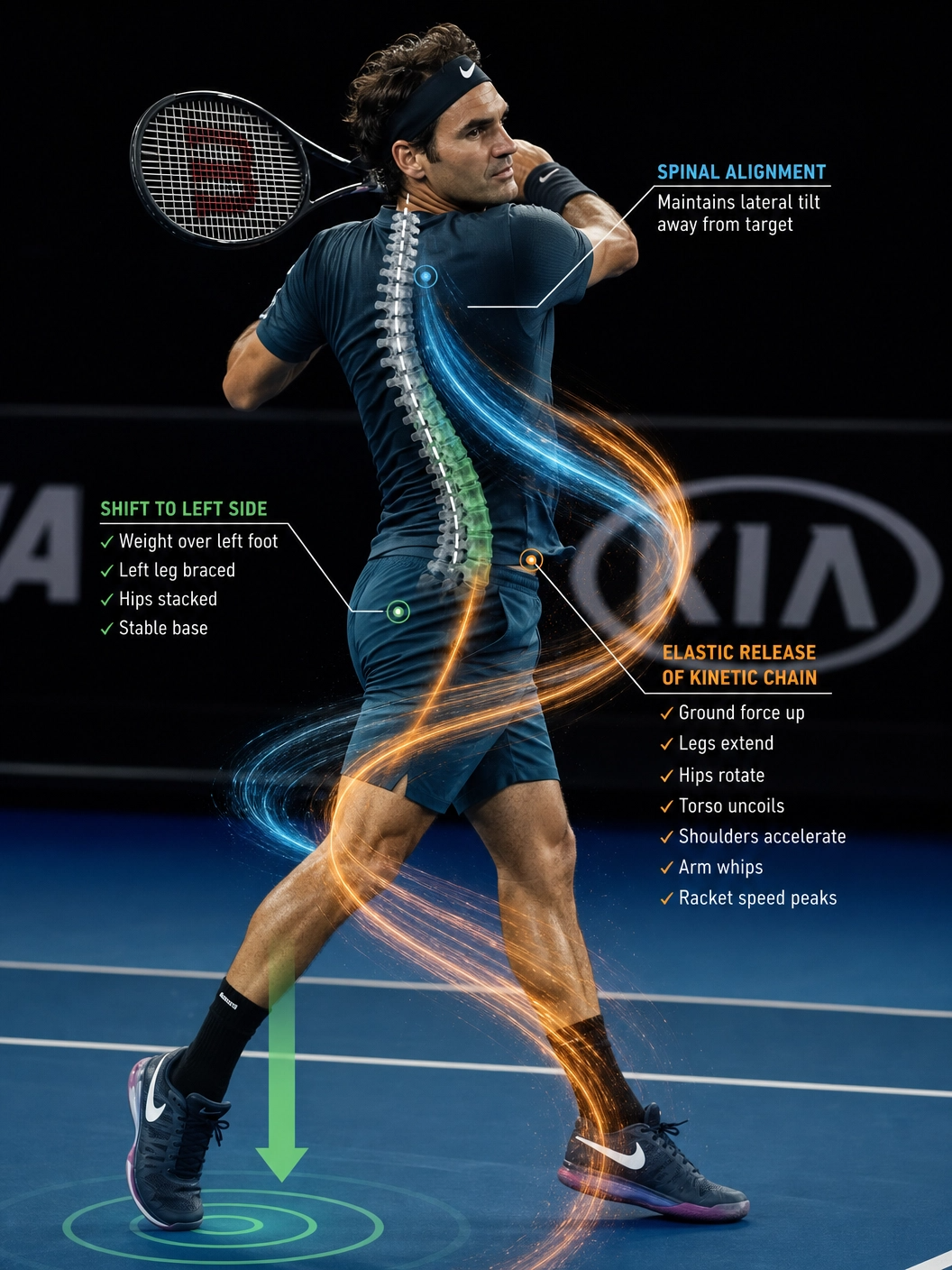
EN: Forehand wrist supination/pronation
Forehand wrist supination/pronation
CUE (EN)
"1. Hold loose — like holding a baby bird 2. Wrist lag = natural speed, not forced 3. Thumb up at contact, palm faces out 4. Pronation is shoulder-driven, not wrist 5. Forearm rotates around its own axis 6. Loose wrist, tight grip is the wrong order 7. Let the ball 'bite' the strings 8. Watch your palm — vertical = neutral 9. Don't snap — let lag release 10. Wrist supinates after contact, not before"
CUE (VI)
"1. Cầm lỏng — như cầm chim non 2. Cổ tay trễ = tốc độ tự nhiên, không ép 3. Ngón cái lên ở tiếp xúc, lòng bàn tay hướng ra 4. Xoay cẳng tay do vai, không phải cổ tay 5. Cẳng tay xoay quanh trục của chính nó 6. Cổ tay lỏng, cầm chặt là sai thứ tự 7. Để bóng 'cắn' dây vợt 8. Nhìn lòng bàn tay — dọc = trung tính 9. Đừng snap — để độ trễ tự bung 10. Cổ tay supinates sau tiếp xúc, không trước"
What the diagram is saying
- Diagrammatic illustration: Forehand wrist supination/pronation
Practical Instructions (Hướng Dẫn Thực Hành)
1. Hold the racket loose, like holding a baby bird — firm enough not to drop, gentle enough not to crush.
1. Cầm vợt lỏng, như cầm chim non — chắc để không rơi, nhẹ để không bẹp.
2. Keep the wrist laid back at contact, not actively bent.
2. Giữ cổ tay laid-back ở tiếp xúc, không gập chủ động.
3. Thumb points up at contact, palm faces out toward the target.
3. Ngón cái hướng lên ở tiếp xúc, lòng bàn tay hướng ra mục tiêu.
4. Pronation is shoulder-driven, not wrist-snap — let the body rotate, the wrist follows.
4. Pronation do vai dẫn, không phải cổ tay — để thân xoay, cổ tay theo.
5. After contact, let the racket continue rotating around the forearm's own axis — no manual flick.
5. Sau tiếp xúc, để vợt tiếp tục xoay quanh trục cẳng tay — không flick bằng tay.
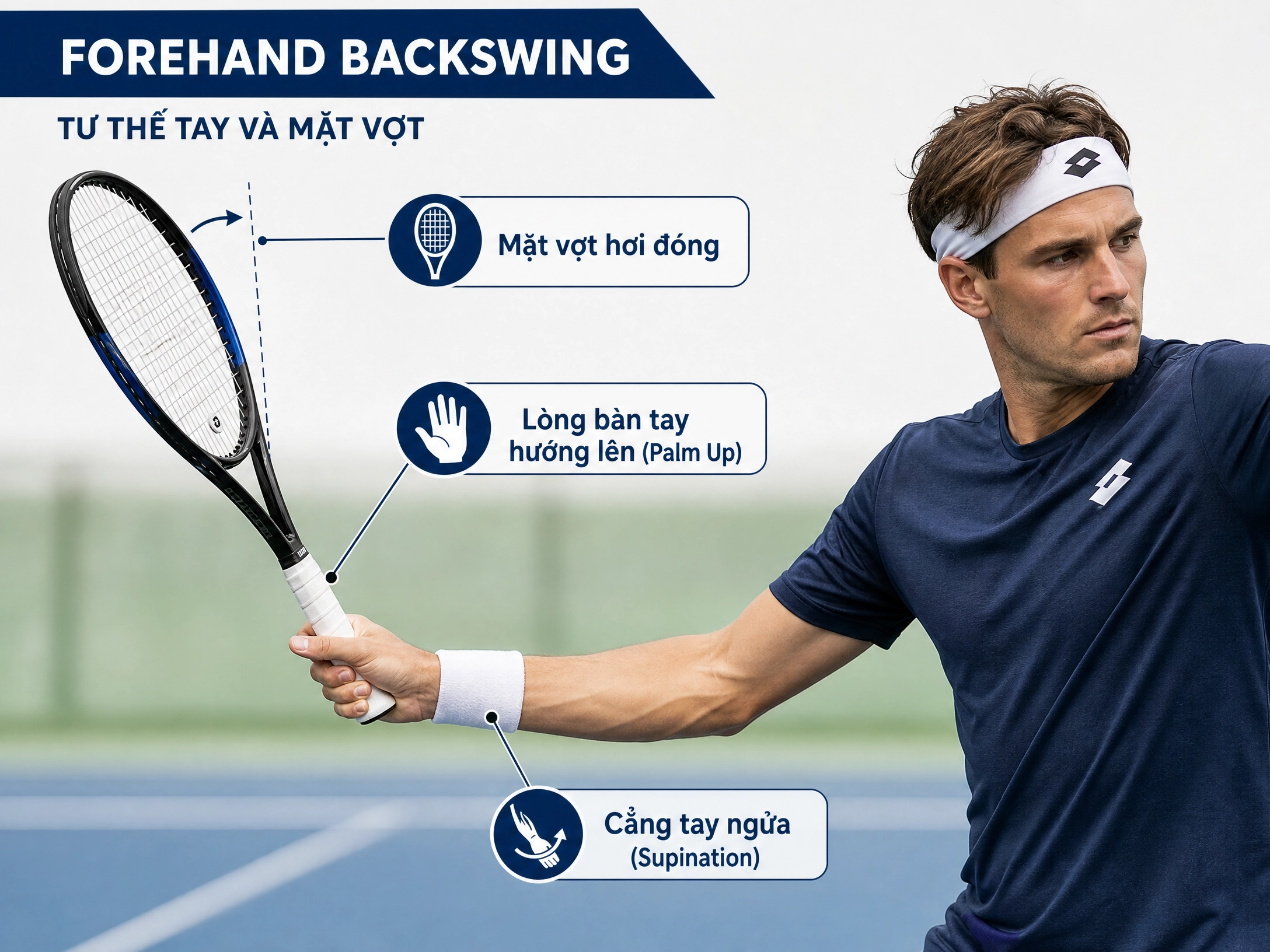
EN: Ball contact path — flat vs topspin
Ball contact path — flat vs topspin
CUE (EN)
"1. Meet the ball out in front 2. Contact at lower part of string bed 3. Don't push through the ball 4. Let the strings bite, then release 5. Flat vs topspin = face angle difference 6. Topspin face angle: 5-10° from vertical 7. Flat face = cleanest power transfer 8. Brush up the back for topspin 9. Lower contact = more control 10. Feel the ball compress into strings"
CUE (VI)
"1. Gặp bóng phía trước người 2. Tiếp xúc ở phần dưới mặt vợt 3. Đừng đẩy xuyên bóng 4. Để dây cắn, rồi bung ra 5. Phẳng vs topspin = khác góc mặt vợt 6. Góc mặt vợt topspin: 5-10° từ dọc 7. Mặt phẳng = truyền lực sạch nhất 8. Quét lên phía sau cho topspin 9. Tiếp xúc thấp hơn = kiểm soát nhiều hơn 10. Cảm nhận bóng nén vào dây"
What the diagram is saying
- Diagrammatic illustration: Ball contact path — flat vs topspin
Practical Instructions (Hướng Dẫn Thực Hành)
1. Meet the ball out in front, not next to the body.
1. Gặp bóng phía trước người, không sát thân.
2. For flat: contact with the racket face vertical, just push through the ball.
2. Phẳng: tiếp xúc mặt vợt dọc, chỉ đẩy xuyên bóng.
3. For topspin: contact lower on the string bed, brush up the back of the ball.
3. Topspin: tiếp xúc thấp ở mặt vợt, quét lên phía sau bóng.
4. The face angle difference between flat and topspin is only 5-10 degrees.
4. Khác biệt góc mặt vợt giữa phẳng và topspin chỉ 5-10°.
5. Feel the ball compress into the strings, then release — let the strings bite.
5. Cảm nhận bóng nén vào dây, rồi thả ra — để dây cắn.
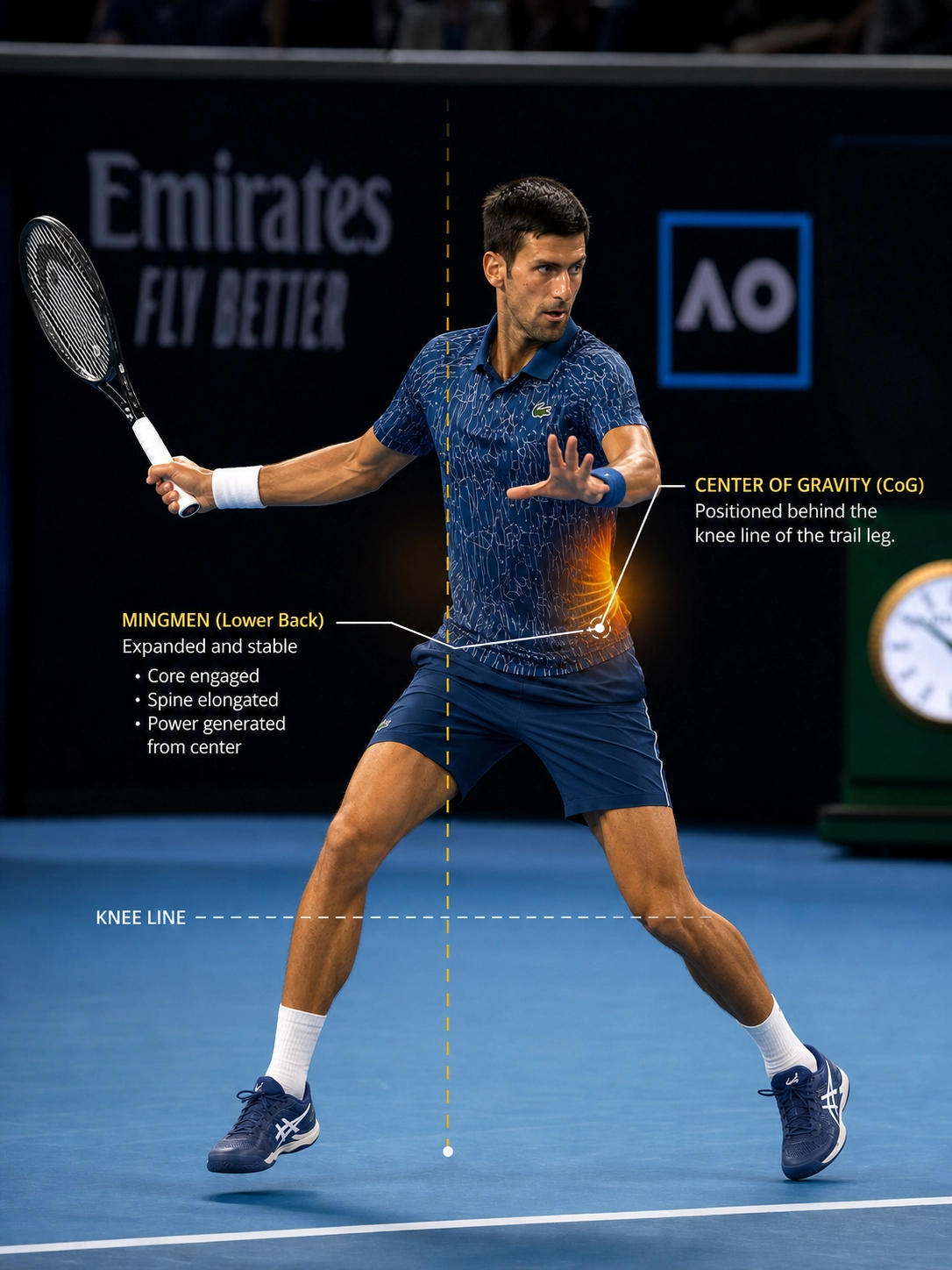
EN: Sling-shot Grip
Sling-shot Grip / "ball out in front"
CUE (EN)
"1. Hold between thumb and middle finger only 2. Drop the racket — feel it fall 3. Loose grip = natural lag 4. Two fingers hold, three fingers release 5. Sling = elbow up, racket head down 6. Beyond the joint = beyond the body's reach 7. The racket falls BEFORE you swing 8. Sling creates whip, swing creates noise 9. Don't squeeze — trust the sling 10. The whip is gravity + rotation"
CUE (VI)
"1. Chỉ cầm giữa ngón cái và ngón giữa 2. Thả vợt — cảm nhận nó rơi 3. Cầm lỏng = độ trễ tự nhiên 4. Hai ngón giữ, ba ngón thả 5. Sling = khuỷu lên, đầu vợt xuống 6. Vượt khớp = vượt tầm cơ thể 7. Vợt rơi TRƯỚC khi bạn vung 8. Sling tạo roi, vung tạo ồn 9. Đừng bóp — tin vào sling 10. Cái roi là trọng lực + xoay"
What the diagram is saying
- Diagrammatic illustration: Sling-shot Grip / "ball out in front"
Practical Instructions (Hướng Dẫn Thực Hành)
1. Hold the racket between thumb and middle finger only — let the other fingers relax.
1. Chỉ cầm giữa ngón cái và ngón giữa — các ngón khác thả lỏng.
2. Drop the racket: feel the head fall freely, gravity creates the lag.
2. Thả vợt: cảm nhận đầu vợt rơi tự do, trọng lực tạo độ trễ.
3. Two fingers hold, three fingers release — keep the grip pressure under 4/10 until contact.
3. Hai ngón giữ, ba ngón thả — giữ grip dưới 4/10 cho tới tiếp xúc.
4. Raise the elbow up, let the racket head drop below the hand — the L-shape.
4. Nâng khuỷu lên, để đầu vợt rơi thấp hơn tay — hình chữ L.
5. At contact, the whip releases: gravity + rotation = speed, not muscle.
5. Ở tiếp xúc, roi bung: trọng lực + xoay = tốc độ, không phải cơ bắp.
EN: OK Grip & Kinetic Chain: Passive Wrist Lag for Effortless Forehand
VI: OK Grip & Chuỗi Động Học — Rơi Tự Nhiên Để Forehand Nhẹ Nhàng
3-phase diagram: SET/NẠP (preparation) → RELEASE/RƠI (drop) → THROW/NÉM (contact/follow-through). Orange = kinetic energy flow, teal = body. Hand grip insets show OK-sign (thumb + middle finger only).
CUE (EN)
"Hold the racket like a small bird. Cầm vợt lỏng lẻo như cầm chim non. Let the racket fall — do not pull it. Để hông dẫn dắt, không phải tay. Wrist lag is the result of relaxation, not effort."
CUE (VI)
"Cầm vợt chỉ bằng ngón cái và ngón giữa (dấu OK). Vợt rơi tự nhiên do quán tính, không kéo chủ động. Hông xoay trước, vai và tay đi theo sau. Cổ tay thả lỏng, đầu vợt trễ lại phía sau bàn tay — đó là 'wrist lag' tự nhiên, hiệu ứng roi quất."
What the diagram is saying
- Phase 1 SET (NẠP): Unit turn + racket back. Racket head up ('Đầu vợt chỉ trời'). Hand grip = OK sign (thumb + middle finger only, no index/ring/pinky). Brain icon = 'feel' not 'think'.
- Phase 2 RELEASE (RƠI): Hip leads, racket drops behind body via inertia. Comparison boxes: LAG THỤ ĐỘNG (passive lag, ✓) vs SNAP CHỦ ĐỘNG (active pull, ✗). Hand label: 'trượt nhẹ trong tay' (slide gently).
- Phase 3 THROW (NÉM): Full hip/torso rotation. Racket meets ball with max head speed. 3 benefit icons: lag feel, timing, elbow protection. Finger pressure 3/10 (fine-tune, not death-grip).
- Kinetic chain arrows flow foot → hip → torso → arm in all 3 phases. Force graph on left = pressure/load over time. Forearm inset shows wrist in lag position (slight extension, not locked).
Practical Instructions (Hướng Dẫn Thực Hành)
1. OK grip: between thumb and middle finger only, three fingers relaxed on the handle.
1. OK Grip: giữa ngón cái và ngón giữa, ba ngón còn lại thả lỏng trên cán vợt.
2. Cầm lỏng — như cầm chim non (hold loose, like holding a baby bird).
2. Cầm lỏng — như cầm chim non.
3. Drop the racket head freely — gravity creates the lag, do not force it.
3. Thả đầu vợt tự do — trọng lực tạo độ trễ, đừng ép.
4. Để hông dẫn dắt (let the hips lead) — hip rotation, then shoulder, then arm, then racket.
4. Để hông dẫn dắt — hông xoay, rồi vai, rồi tay, rồi vợt.
5. At contact, the whip releases: 2 fingers hold, 3 fingers release, racket head whips through.
5. Ở tiếp xúc, roi bung: 2 ngón giữ, 3 ngón thả, đầu vợt quất qua.
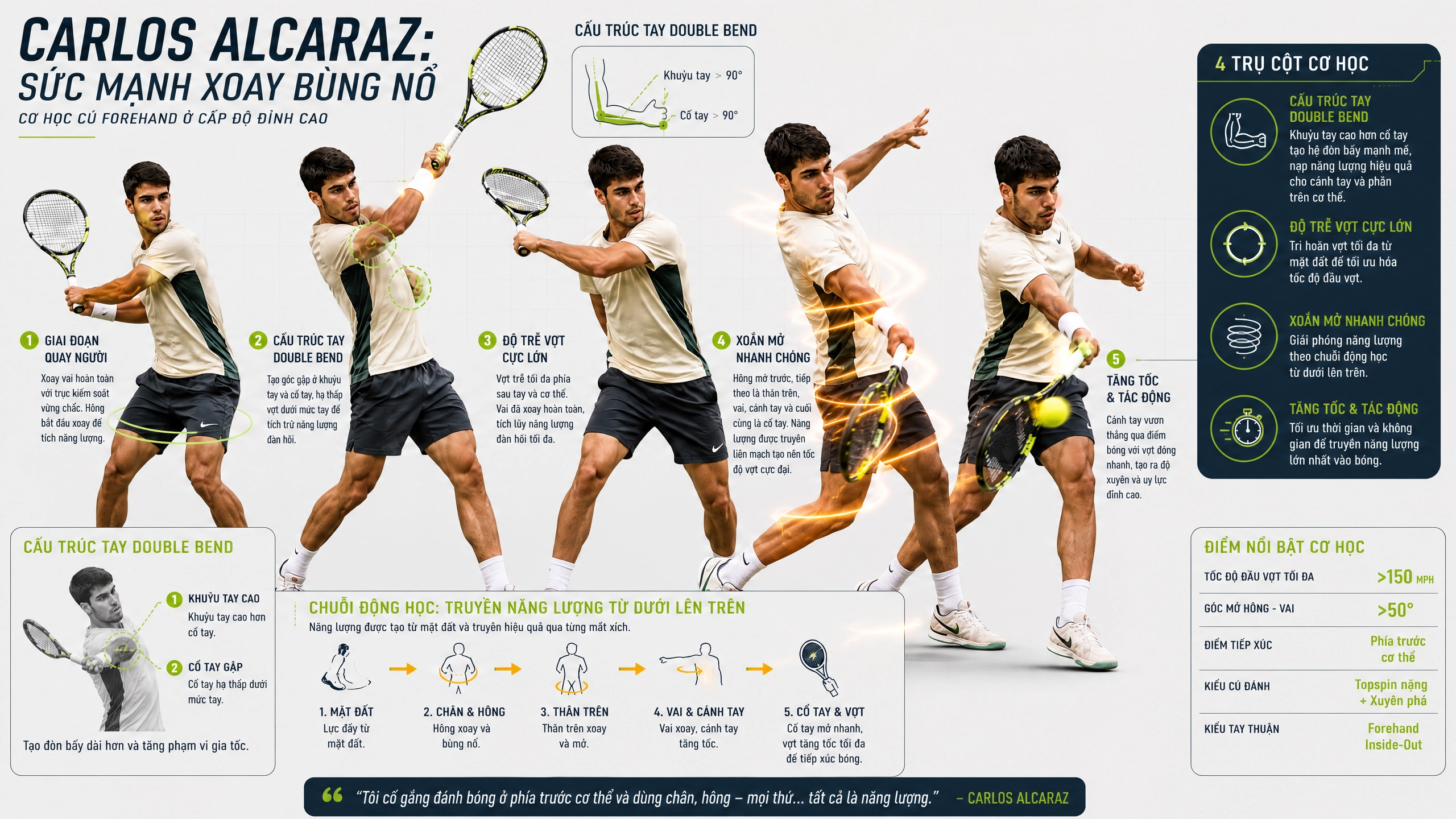
EN: Forehand & Backhand Embodied Training: From Neural Control to Match
VI: Forehand & Backhand Qua Lăng Kính Embodied — Từ Thần Kinh Đến Trận Đấu
3-section framework: (1) Foundation: balance + body schema (head/neck stability, OK grip constraint, bare foot, racket embodiment). (2) Kinetic chain + stance (GRF/ISR diagram, open stance FH, closed stance BH). (3) Perception/reaction/flow (novice brain vs advanced brain, pre/in/post-point model).
CUE (EN)
"Don't think about the swing. Think about the ball, the target, the opponent's body. Forehand is not a movement to perform — it is a response to a perceived situation. The technique emerges from perception."
CUE (VI)
"Mô hình truyền thống: Kỹ thuật → Lặp lại → Trận đấu. Mô hình Embodied: Nhận thức → Hành động → Thích nghi → Kỹ năng. Người mới dùng tay đánh bóng, mất kết nối với chân, mất cân bằng sau cú đánh. Người giỏi cảm nhận lực từ mặt sân, truyền lực qua toàn thân, giữ ổn định đầu và mắt. Kỹ thuật xuất hiện như kết quả của sự thích nghi, không phải mục tiêu ban đầu."
What the diagram is saying
- Section 1 (Foundation): Head + neck stability as gyroscope (Taichi principle), barefoot GRF perception, racket as 'extended body schema' (tool embodiment).
- Section 2 (Kinetic Chain): Central anatomical figure with colored arrows — green=GRF, red=torso, yellow=arm, green=pronation, purple=ISR (Internal Shoulder Rotation). Open stance forehand pushes from back leg (SSC), closed stance backhand uses deep leg coil + massive rotation.
- Section 3 (Perception/Flow): Novice brain thinks about process (internal focus, 'think → move'). Advanced brain focuses on target (external focus, 'see → move', flow). 3-phase match model: pre-point (breath, barefoot feel) → in-point (rapid predict-act) → post-point (affordance summary + error correction).
- Cross-citation: [1.1] = balance/head position, [2.1] = racket embodiment, [3.1] = match flow. Source paper referenced but not full-cited (likely the user's own 'Tennis_Forehand_Biomechanics_A_Visual_Analysis.docx').
Practical Instructions (Hướng Dẫn Thực Hành)
1. Perception → Action → Adaptation → Skill (not Technique → Repetition → Match).
1. Nhận thức → Hành động → Thích nghi → Kỹ năng (không phải Kỹ thuật → Lặp lại → Trận đấu).
2. Feel breath, barefoot, sensory feel — re-establish the body-court connection.
2. Cảm nhận hơi thở, chân trần, cảm giác giác quan — tái lập kết nối thân-sân.
3. Rapid Predict → Act at the contact moment — read the ball, then commit.
3. Dự đoán nhanh → Hành động lúc tiếp xúc — đọc bóng, rồi commit.
4. After contact: summarize the affordance, feed it back to the neural model.
4. Sau tiếp xúc: tóm tắt affordance, cho ăn lại mô hình thần kinh.
5. The technique emerges from perception, not the other way around — embody the stroke.
5. Kỹ thuật xuất hiện từ nhận thức, không ngược lại — nhập thể cú đánh.
3 takeaway cuối
- (1) Phân bổ lực là chuỗi, không phải cánh tay. Internal rotation đóng 40%; arm swing chỉ là passenger.
- (2) Bent-back + straight-front stance là foundation. COG in the base. Mọi groundstroke bắt đầu từ đây.
- (3) Compact wins over big. Brief loop + hip forward + hop counter là đủ để tạo racket head speed.
Drills tham khảo (20-min practice)
- 5 phút Shadow với khăn (zero ball) — chỉ tập chuỗi chân → hông → tay, không bóng.
- 5 phút Hit from basket từ middle baseline, target: 7/10 quả vào 1m zone bên trong baseline.
- 5 phút Cross-court rally — chỉ tập redirect, không cố kill.
- 5 phút Service-box volley poach (compact finish) — lặp lại cú compact stroke ở forehand.
End of FOREHAND
Henry Pham · Visual Coaching Library · Pilot Series · June 2026