Visual Coaching Library
5R Ready-Read-React-Respond-Recover
5 cards · master-coach-direct
Footwork không phải chạy nhanh — nó là timing. Dave Bailey (5R model) chia 5 pha: Ready, Read, React, Respond, Recover. Người chơi 50+ hay kẹt ở pha Ready (đứng flat-footed) hoặc Recover (đứng ngắm bóng).
Hai ảnh dưới đây minh hoạ: chân trước/chéo stance 90° quyết định hướng bóng (cross-court vs down-the-line), và bài tập 5R cụ thể cho 50+ từ ghi chép của bạn.
June 2026 — bilingual EN + VI
Source: MD notes + Gemini-generated images
Index of Cards
- Foot Placement: Inside Foot, 90° Stance
- Ready Stance: Not Flat-Footed, Not Too Unbalanced
- Footwork stances
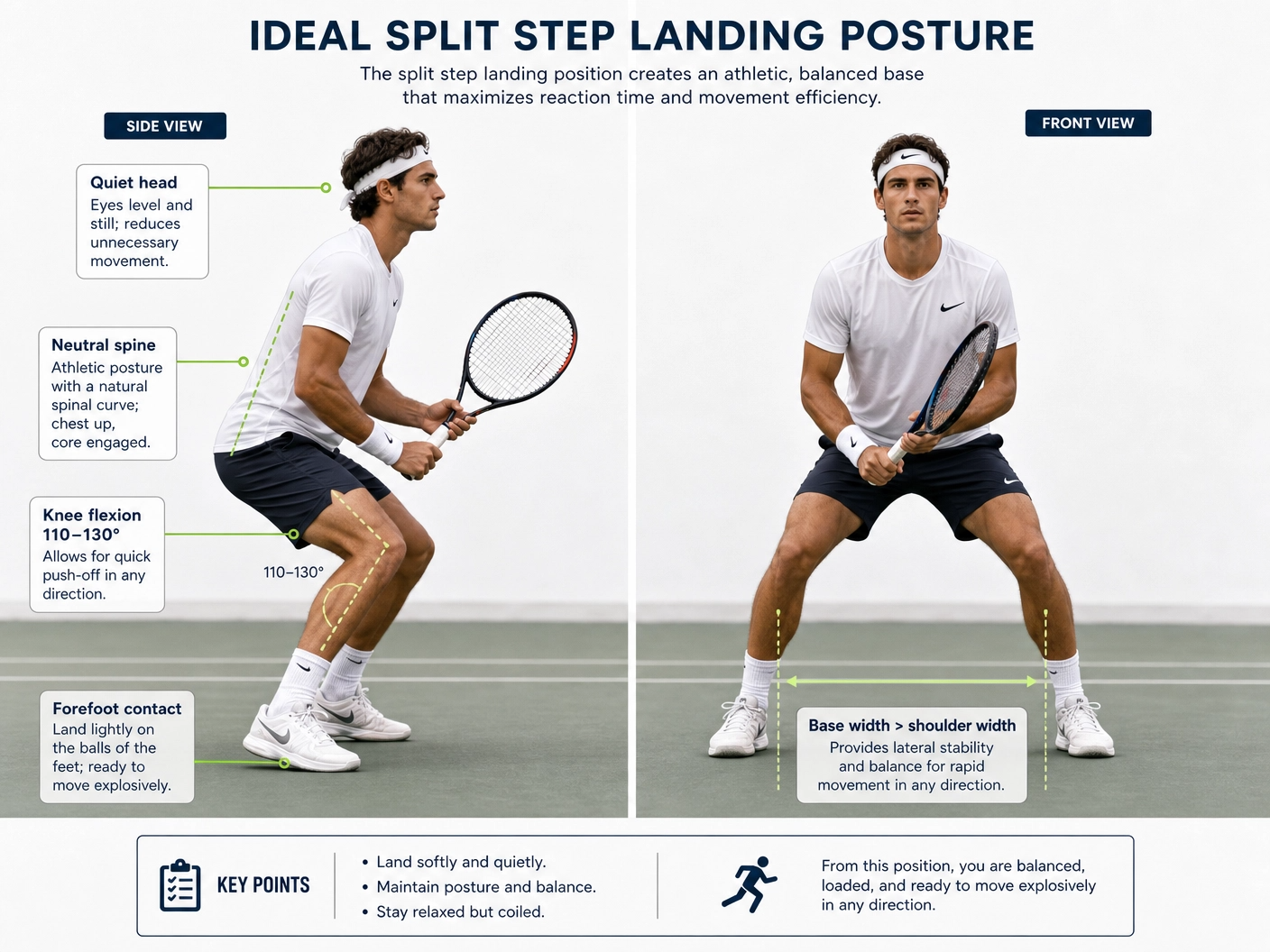
- split step footwork
- Ready & Racket Prep position
EN: Foot Placement: Inside Foot, 90° Stance
VI: Vị trí chân: chân trong, stance 90°
Open-stance footwork cheat-sheet: plant inside foot perpendicular to baseline; cross-court = inside foot, down-the-line = outside leg.
CUE (EN)
"Plant the inside foot perpendicular to the line — cross-court goes from the inside foot, down-the-line from the outside leg."
CUE (VI)
"Đặt chân trong vuông góc với baseline — cross-court từ chân trong, down-the-line từ chân ngoài."
What the diagram is saying
- Top callouts: 'Follows' and 'Step out' — two open-stance patterns (follow-through vs recover to centre).
- Central 90° foot-angle diagram: feet perpendicular to baseline, weight loaded on inside foot.
- Court diagram with arrows showing shot direction (cross-court vs down-the-line).
- Hand-drawn notebook style matching the source notes (PXL_*.jpg references).
Practical Instructions (Hướng Dẫn Thực Hành)
1. Plant the inside foot (right foot for forehand) pointing at the sideline.
1. Trồng chân trong (chân phải cho forehand) hướng về đường biên.
2. Rotate the foot 90° to the court, hip opens, weight transfers forward.
2. Xoay chân 90° về sân, hông mở, trọng lượng chuyển tới.
3. Stagger the other foot behind, ready to push off in any direction.
3. So le chân kia ra sau, sẵn sàng đẩy theo bất kỳ hướng nào.
4. Avoid the open stance as default — use 90° for power, open only for emergency recovery.
4. Tránh open stance làm mặc định — dùng 90° cho lực, open chỉ cho phục hồi khẩn cấp.
5. Push off the back foot immediately after contact to recover to the middle.
5. Đẩy chân sau ngay sau tiếp xúc để phục hồi về giữa.
EN: Ready Stance: Not Flat-Footed, Not Too Unbalanced
VI: Stance sẵn sàng: không flat, không lệch
Reused from forehand card 2 — hand-drawn stick figure of legs only with COG, FHGS/BHGS reference table, front leg flat + back leg heel-up.
CUE (EN)
"Ready stance = front leg flat (brake) + back leg heel-up (accelerator). Staggered, not square. One bounce = ready."
CUE (VI)
"Stance sẵn sàng = chân trước flat (phanh) + chân sau nhón gót (ga). So le không vuông. Một bounce = sẵn sàng."
What the diagram is saying
- Stick figure (legs only) with 3 annotations: COG = IN the base, back leg = bent, front leg = straight.
- Reference table: FHGS = front leg = Left / back leg = Right; BHGS = front leg = Right / back leg = Left.
- Hand-drawn pencil-sketch style matching the source notes aesthetic.
Practical Instructions (Hướng Dẫn Thực Hành)
1. Front leg flat (brake), back leg heel-up (accelerator) — staggered, not square.
1. Chân trước phẳng (phanh), chân sau nhón gót (ga) — so le, không vuông.
2. Weight on the balls of both feet, knees soft, body ready to move in any direction.
2. Trọng lượng trên mũi cả hai chân, gối mềm, thân sẵn sàng di chuyển mọi hướng.
3. One bounce = ready — use the bounce to feel the ground, not to shift weight side-to-side.
3. Một bounce = sẵn sàng — dùng bounce để cảm nhận đất, không để đu chuyển trọng lượng.
4. If you can bounce, shuffle, or change direction without resetting, you're in it.
4. Nếu có thể bounce, shuffle, đổi hướng mà không reset chân, bạn đang ở trong nó.
5. Staggered step: 1 foot in front, 1 foot behind, always ready, never flat-footed.
5. Bước so le: 1 chân trước, 1 chân sau, luôn sẵn sàng, không flat-footed.
EN: Footwork stances
Footwork stances
CUE (EN)
"1. Open stance = power, both feet planted 2. Closed stance = control, weight transfer 3. Neutral stance = balance, mid-court 4. Push by back leg, bridge by front 5. Bend back, straight front 6. COG = in the base, not over it 7. Square stance for transitions 8. Open stance for emergency 9. Low center of gravity in neutral 10. Stance = foundation, always"
CUE (VI)
"1. Stance mở = lực, cả hai chân cắm đất 2. Stance đóng = kiểm soát, chuyển trọng tâm 3. Stance trung tính = cân bằng, giữa sân 4. Đẩy bằng chân sau, bắc cầu bằng chân trước 5. Chân sau gập, chân trước thẳng 6. COG = trong đế, không trên đế 7. Stance vuông cho chuyển tiếp 8. Stance mở cho tình huống khẩn cấp 9. Trọng tâm thấp ở stance trung tính 10. Stance = nền tảng, luôn luôn"
What the diagram is saying
- Diagrammatic illustration: Footwork stances
Practical Instructions (Hướng Dẫn Thực Hành)
1. Open stance: power, quick recovery, but burns energy — use for emergency shots.
1. Open stance: lực, phục hồi nhanh, nhưng tốn năng lượng — dùng cho cú khẩn cấp.
2. Closed stance: control, more time to set up — use for high balls and slices.
2. Closed stance: kiểm soát, nhiều thời gian setup — dùng cho bóng cao và slice.
3. Neutral stance: balance, transition between open and closed — use for mid-court shots.
3. Neutral stance: cân bằng, chuyển tiếp giữa open và closed — dùng cho bóng giữa sân.
4. Push by back leg, bridge by front leg — every stance has a power side and a brake side.
4. Đẩy bằng chân sau, cầu bằng chân trước — mọi stance có bên lực và bên phanh.
5. Match stance to ball height: low balls need open stance, high balls need closed.
5. Khớp stance với độ cao bóng: bóng thấp cần open, bóng cao cần closed.
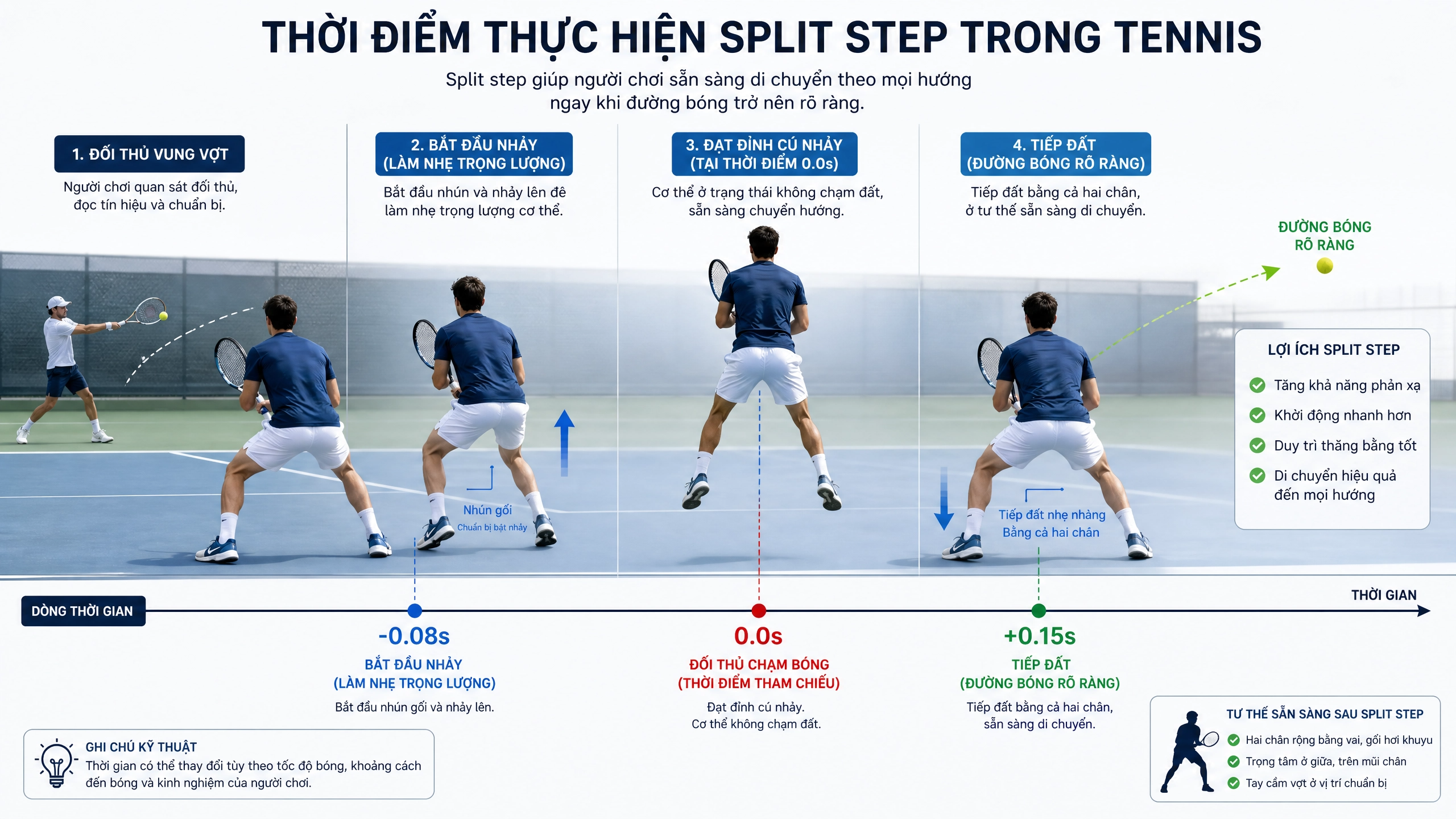
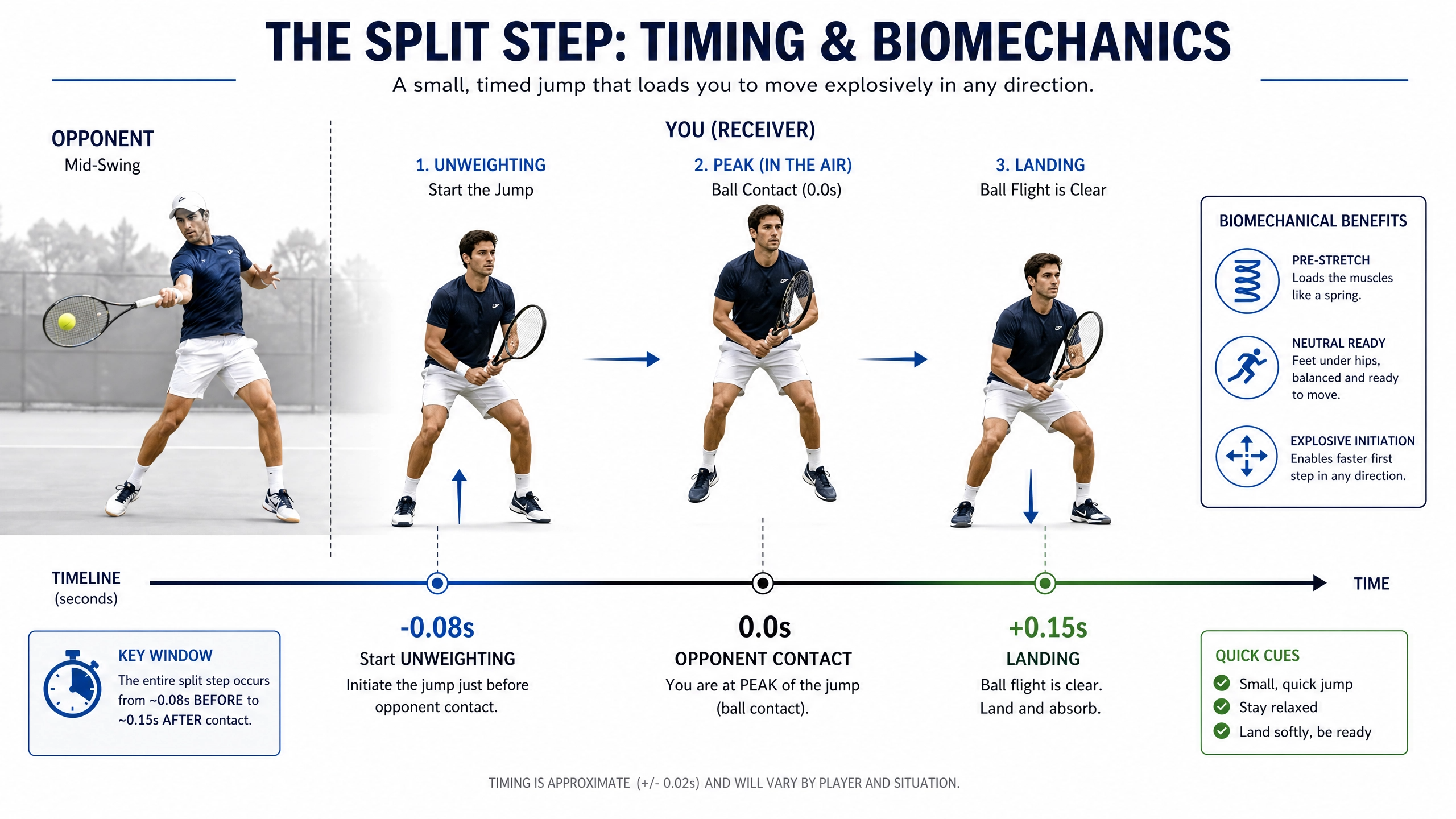
EN: split step footwork
split step footwork
CUE (EN)
"1. Hop on their contact, not after 2. Small hop, not big jump 3. Land on balls of feet 4. Cat feet, not kangaroo 5. Split is the launch pad 6. Mistime by half a beat = late 7. Fast rally = split earlier 8. Slow dinker = delay split 9. Split = readiness signal to brain 10. Practice 10 splits in living room"
CUE (VI)
"1. Nhảy lúc họ tiếp xúc, không sau 2. Nhảy nhỏ, không nhảy cao 3. Tiếp đất trên mũi chân 4. Chân mèo, không chân kangaroo 5. Split là bệ phóng 6. Lệch nửa nhịp = trễ 7. Trao đổi nhanh = split sớm hơn 8. Bóng chậm = trễ split 9. Split = tín hiệu sẵn sàng cho não 10. Tập 10 split ở phòng khách"
What the diagram is saying
- Diagrammatic illustration: split step footwork
Practical Instructions (Hướng Dẫn Thực Hành)
1. Hop on their contact, not after — the split step is timed to the opponent's strike.
1. Nhảy ở thời điểm đối thủ chạm bóng, không phải sau — split step định giờ theo cú đánh của họ.
2. Cat feet, not kangaroo — low, quiet, controlled, both feet leave the ground together.
2. Chân mèo, không phải kangaroo — thấp, êm, kiểm soát, cả hai chân rời đất cùng lúc.
3. Land on the balls of the feet, weight forward, ready to move in any direction.
3. Tiếp đất trên mũi chân, trọng lượng tới, sẵn sàng di chuyển mọi hướng.
4. Practice 10 split steps at home with a metronome — make it automatic, not conscious.
4. Tập 10 split step ở nhà với metronome — biến thành tự động, không ý thức.
5. Without split step, you start every rally a half-step behind — split step is the launch pad.
5. Không split step, bạn bắt đầu mỗi rally nửa bước sau — split step là bệ phóng.
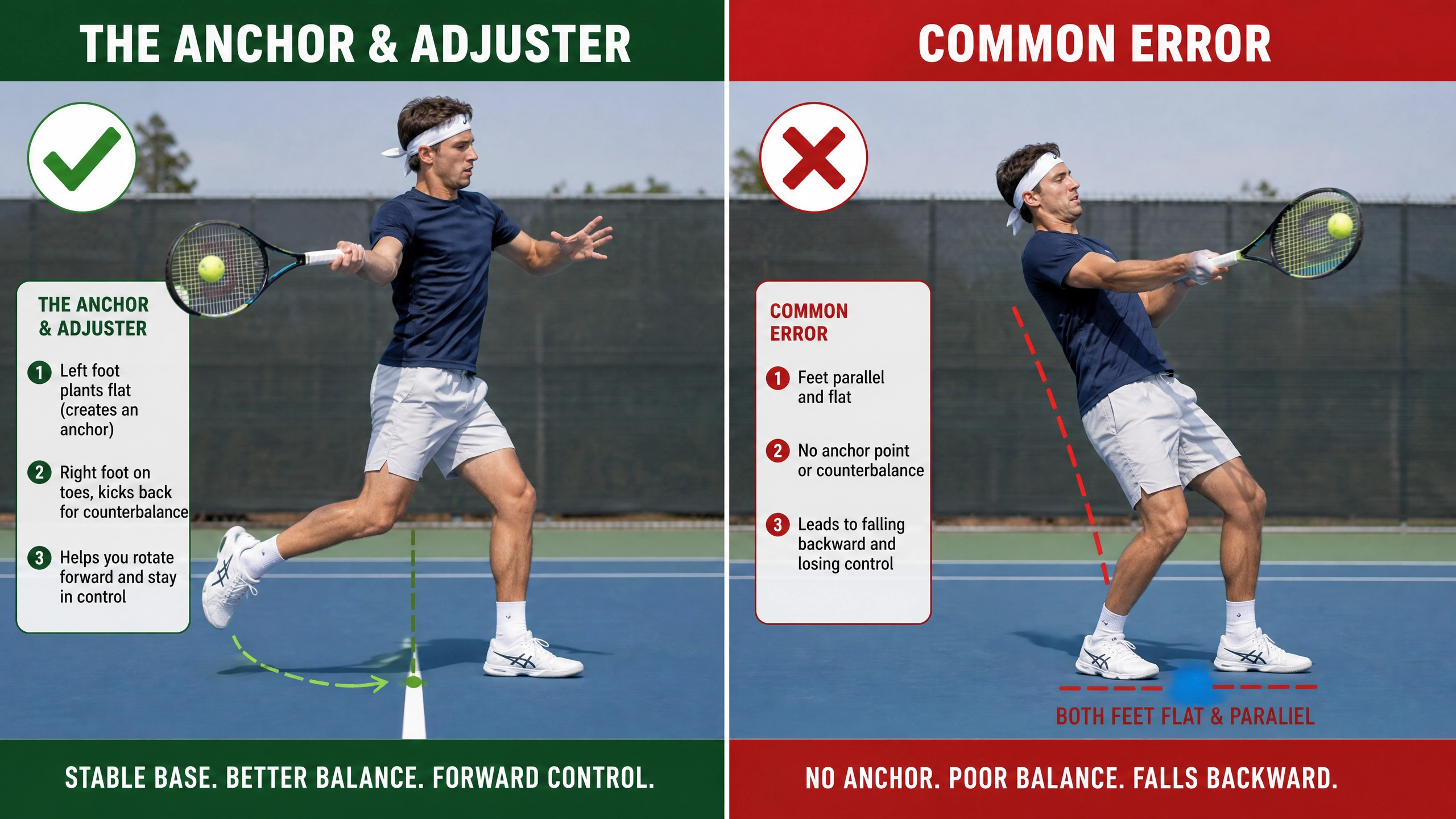
EN: Ready & Racket Prep position
Ready & Racket Prep position
CUE (EN)
"1. Racket up before the ball 2. Butt cap points to net 3. Two-hand grip until you decide 4. Opposite hand tension = ready 5. Staggered feet, not square 6. Front leg flat, back leg heel-up 7. One bounce = ready 8. Don't drop the racket head 9. Toss and split = automatic prep 10. Prep before decision, not after"
CUE (VI)
"1. Vợt lên trước khi bóng đến 2. Đáy cán vợt hướng lưới 3. Cầm hai tay cho đến khi quyết định 4. Tay đối diện căng = sẵn sàng 5. Chân so le, không vuông 6. Chân trước flat, chân sau nhón gót 7. Một bounce = sẵn sàng 8. Đừng để đầu vợt rơi 9. Toss và split = chuẩn bị tự động 10. Chuẩn bị trước quyết định, không sau"
What the diagram is saying
- Diagrammatic illustration: Ready & Racket Prep position
Practical Instructions (Hướng Dẫn Thực Hành)
1. Racket up, butt cap pointing to the net — do not let the racket head drop below the hand.
1. Vợt lên, butt cap chỉ về lưới — đừng để đầu vợt rơi thấp hơn tay.
2. Staggered feet, weight on the balls, knees soft, head still, eyes on the opponent.
2. Chân so le, trọng lượng trên mũi, gối mềm, đầu yên, mắt nhìn đối thủ.
3. Prep before the decision is made — by the time you read the direction, racket is already up.
3. Prep trước khi quyết định — khi bạn đọc hướng, vợt đã lên rồi.
4. The non-dominant hand supports the throat of the racket for stability and quick transitions.
4. Tay không thuận giữ cổ vợt để ổn định và chuyển trạng thái nhanh.
5. From ready, the next move is split step — ready is the start, not the end.
5. Từ ready, bước tiếp theo là split step — ready là khởi đầu, không phải kết thúc.
3 takeaway cuối
- (1) Ready = cat feet (low, quiet) chứ không phải kangaroo hop. Time split-step vào lúc đối thủ đánh, không phải sau.
- (2) Shuffle khi có thể, cross-step khi buộc phải. Tránh back-pedal với lobs — pivot, open hips, cross-step backward.
- (3) Recover = 2-3 bước về vị trí trung lập. Đừng đứng ngắm bóng — automatic split-move-strike-recover.
Drills tham khảo (20-min practice)
- 5 phút 10 split-steps với metronome ở nhà. Cat-feet (low, quiet), không high-jump.
- 5 phút Partner 'call shot': partner feed không báo trước, bạn gọi 'forehand' hoặc 'backhand' ngay khi thấy prep.
- 5 phút Shadow swing trong tất (no-shoes): buộc stabilizers làm việc, dạy micro-steps.
- 5 phút Wide-ball recovery: 3 cú xa trái/phải liên tiếp → 2-3 cross-step + shuffle về middle.
End of FOOTWORK
Henry Pham · Visual Coaching Library · Pilot Series · June 2026