Tennis Biomechanics Analysis Report
Stroke: Serve & Forehand Groundstroke Author: Manus AI Date: May 30, 2026 Subject: Biomechanical Analysis of Optimal Arm Configuration using Neurological Control Theory
Executive Summary
This report provides a comprehensive biomechanical analysis of optimal arm configuration in tennis serves and forehand groundstrokes, integrating insights from the user's coaching notes with advanced neurological control theory and kinetic chain principles. The core finding emphasizes the critical role of the arm acting as a mass-spring system rather than a rigid lever, facilitating elastic energy storage and release, maximizing racket head speed, and minimizing injury risk. Key elements include maintaining a bent elbow, a loose wrist with controlled tension, and strategic ulnar deviation. This configuration optimizes spacing, swing efficiency, and tension control, moving stability up the kinetic chain from the wrist to the larger muscle groups of the shoulder and torso. The analysis integrates concepts of neurological control layers, structural setpoints, and kinetic chain principles to explain how these arm mechanics contribute to both power and precision, applicable across both serve and forehand strokes.
Introduction
In tennis, the arm configuration during strokes, particularly the serve and forehand groundstroke, is a pivotal determinant of power, control, and injury prevention. While often perceived as a simple extension of the body, the arm functions as a complex biomechanical system, intricately linked to the entire kinetic chain. This report delves into the optimal arm mechanics for these strokes, moving beyond superficial observations to explore the underlying neurological and biomechanical principles that govern efficient movement. By analyzing the interplay of muscle activation, joint angles, and energy transfer, we aim to demystify the seemingly contradictory coaching cues, such as "loose wrist to keep controlled tension," and provide a scientifically grounded understanding of effective arm use.
Our analytical approach integrates insights from contemporary tennis coaching with established biomechanical and neurological control theories. We will examine how the Central Nervous System (CNS) orchestrates movement through hierarchical layers, how kinetic chain principles dictate efficient force transmission, and the significance of specific structural setpoints. The goal is to provide a comprehensive framework that not only explains what optimal arm configuration looks like but also why it is effective, offering actionable insights for players and coaches seeking to enhance performance and mitigate injury risks.
Foundational Concepts
1. The Arm as a Mass-Spring System: Elastic Energy Storage and Release
The concept of the arm functioning as a "mass spring" is central to modern tennis biomechanics, contrasting sharply with the less efficient "locked lever" approach. Instead of rigidly muscling the ball with a stiff arm, the optimal configuration allows the arm to act as a coiled spring, storing and releasing elastic energy [1]. This is achieved by maintaining a bent elbow and a relaxed shoulder, which enables the larger muscles to stretch and then rapidly snap back in a stretch-shortening cycle [1]. This process effectively harnesses free energy, significantly reducing the muscular effort required to generate racket head speed and contributing to a more fluid and powerful stroke [1]. Research on human movement often utilizes mass-spring-damper models to describe the body's response to impacts and to simulate arm movements in sports, further validating this concept [2, 3]. The arm's ability to behave as an elastic structure is a key differentiator between elite and amateur players, allowing for greater power with less perceived effort.
2. Loose Wrist with Controlled Tension: The Paradox of Power and Control
The coaching cue to maintain a "loose wrist to keep controlled tension" may seem contradictory, yet it represents a sophisticated understanding of neuromuscular control in tennis [1]. A truly loose wrist allows the racket to lag behind the hand during the swing, a critical component for generating racket head speed and spin [1]. This "lag" stores elastic energy in the wrist and forearm, which is then released explosively at the moment of impact, creating a whip-like effect [4]. However, this looseness is not synonymous with floppiness. Controlled tension refers to the engagement of larger muscle groups in the upper arm, chest, and forearm, which guide the racket's path and maintain the overall structural integrity of the arm [1]. This nuanced balance ensures that the wrist remains pliable enough to facilitate lag while the broader arm structure provides stability and direction. A death grip, conversely, eliminates lag, reduces racket head speed, and increases the risk of injury [1]. Studies on wrist motion in tennis players highlight that advanced players exhibit smaller, more controlled wrist movements, indicating refined neuromuscular control that balances flexibility with stability [5].
3. Ulnar Deviation: Optimizing Racket Path and Spin
Ulnar deviation, the bending of the wrist towards the pinky finger, is a specific structural setpoint that plays a crucial role in both the serve and forehand [1]. In the serve, ulnar deviation is observed during the preparation phase, contributing to increased racket speed [1]. For the forehand, it allows the racket head to drop below the ball, facilitating an upward brushing motion that generates topspin [1]. This wrist position is not merely a stylistic choice but a biomechanically advantageous alignment that optimizes the racket's path and angle relative to the ball, enhancing both power and spin generation. While beneficial for performance, it is important to note that excessive or unsupported ulnar deviation can contribute to ulnar-sided wrist pain and injury, particularly affecting the extensor carpi ulnaris (ECU) [1, 5]. Therefore, proper strength and mobility in the wrist and forearm are essential to support this critical setpoint.
4. Bent Arm vs. Tensed Straight Arm: Efficiency and Injury Prevention
The distinction between a bent arm and a tensed straight arm at contact is fundamental to efficient tennis technique. The user's notes explicitly state "≠ tensed straight arm," underscoring the detrimental effects of a locked elbow [1]. A bent arm, often described as a "C" shape, brings the contact point closer to the body's core, creating a stronger, more balanced position that allows for greater control and flexibility [6]. This configuration enables the body to twist, turn, and adjust without creating resistance in the kinetic chain, leading to a fluid and relaxed stroke [6]. Conversely, a straight, tensed arm forces the player to make contact further in front of the body, diminishing the hitting zone and leaving little room for error [6]. This rigid approach transfers excessive shock into the elbow and wrist, increasing the risk of injuries such as tennis elbow, as studies show a correlation between excessive wrist extensor force and poor mechanics [1, 5]. Biomechanically, a bent lever is inherently more stable and stronger than a straight one, providing a more robust platform for force transmission [6].
5. Neurological Control Layers
The execution of these arm mechanics is orchestrated by the Central Nervous System (CNS) through a hierarchical control framework [7]:
- Layer 1 - Intent (Prefrontal & Motor Cortex): This layer governs the conscious decision-making regarding shot selection, desired trajectory, spin, and power. For optimal arm configuration, this involves the conscious choice to prioritize elastic energy generation and a fluid swing over brute force [7].
- Layer 2 - Execution & Refinement (Basal Ganglia & Cerebellum): Learned motor programs for the serve and forehand are initiated here, with the cerebellum continuously refining movements based on sensory feedback. This layer ensures smooth transitions between phases of the stroke and real-time error correction, adapting the arm's motion to incoming ball conditions [7].
- Layer 3 - Automation (Central Pattern Generators & Spinal Cord): With practice, basic motor patterns, such as the rhythmic rotation of the torso and the sequential acceleration of arm segments, become automated. This reduces the cognitive load, allowing higher brain centers to focus on tactical aspects rather than minute muscle control [7]. The mass-spring action of the arm, once learned, operates largely at this automated level.
- Layer 4 - Sensorimotor Feedback (Proprioceptors & Vestibular System): Continuous real-time monitoring of body position, movement, and balance is provided by proprioceptors in muscles and joints, and the vestibular system. This feedback is crucial for maintaining the precise joint angles and muscle tension required for the optimal arm configuration, allowing for immediate adjustments during the stroke [7]. The "feel" of a loose wrist and controlled tension is heavily reliant on accurate proprioceptive feedback.
6. Major Functions of the Arm in Tennis Strokes
In the context of optimal arm configuration, the arm performs several critical functions:
- Elastic Energy Generation: The bent arm and loose wrist facilitate the stretch-shortening cycle, storing and releasing elastic energy for power [1].
- Racket Head Speed Acceleration: Through proximal-to-distal sequencing and the whip-like action of the wrist, the arm is the final segment to accelerate the racket head to maximum velocity [1, 4].
- Control and Direction: While appearing loose, the arm, in conjunction with the shoulder and torso, provides the necessary stability and guidance for accurate ball placement [1, 6].
- Impact Absorption: The flexible, non-rigid structure of the arm, particularly the bent elbow, helps to absorb the shock of impact, protecting joints from excessive stress [1, 6].
- Spacing and Hitting Zone Optimization: The bent arm allows for a contact point that is optimally spaced from the body, creating a larger and more forgiving hitting zone [1, 6].
Visual Analysis
Kinetic Chain Diagram
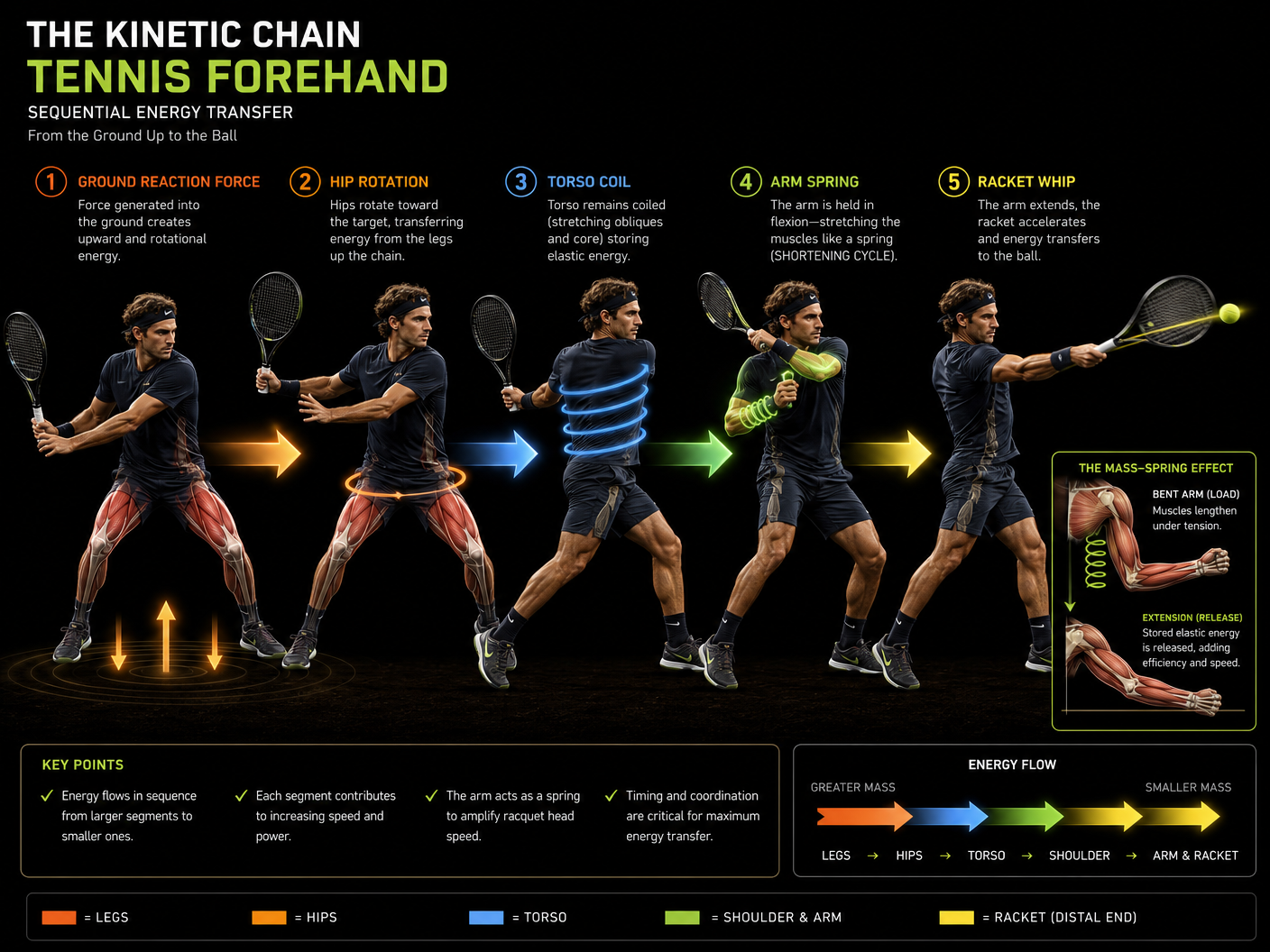
Figure 1: Kinetic Chain of the Tennis Forehand. This diagram illustrates the sequential energy transfer from the ground up to the racket. Power originates from ground reaction forces (1), is amplified through hip rotation (2) and torso coil (3), and is then funneled into the arm, which acts as a spring (4) before culminating in the final racket whip (5). The "mass-spring effect" is highlighted in the bent arm, showing how muscles lengthen under tension to store energy for an explosive release.
Muscle Activation Heatmap
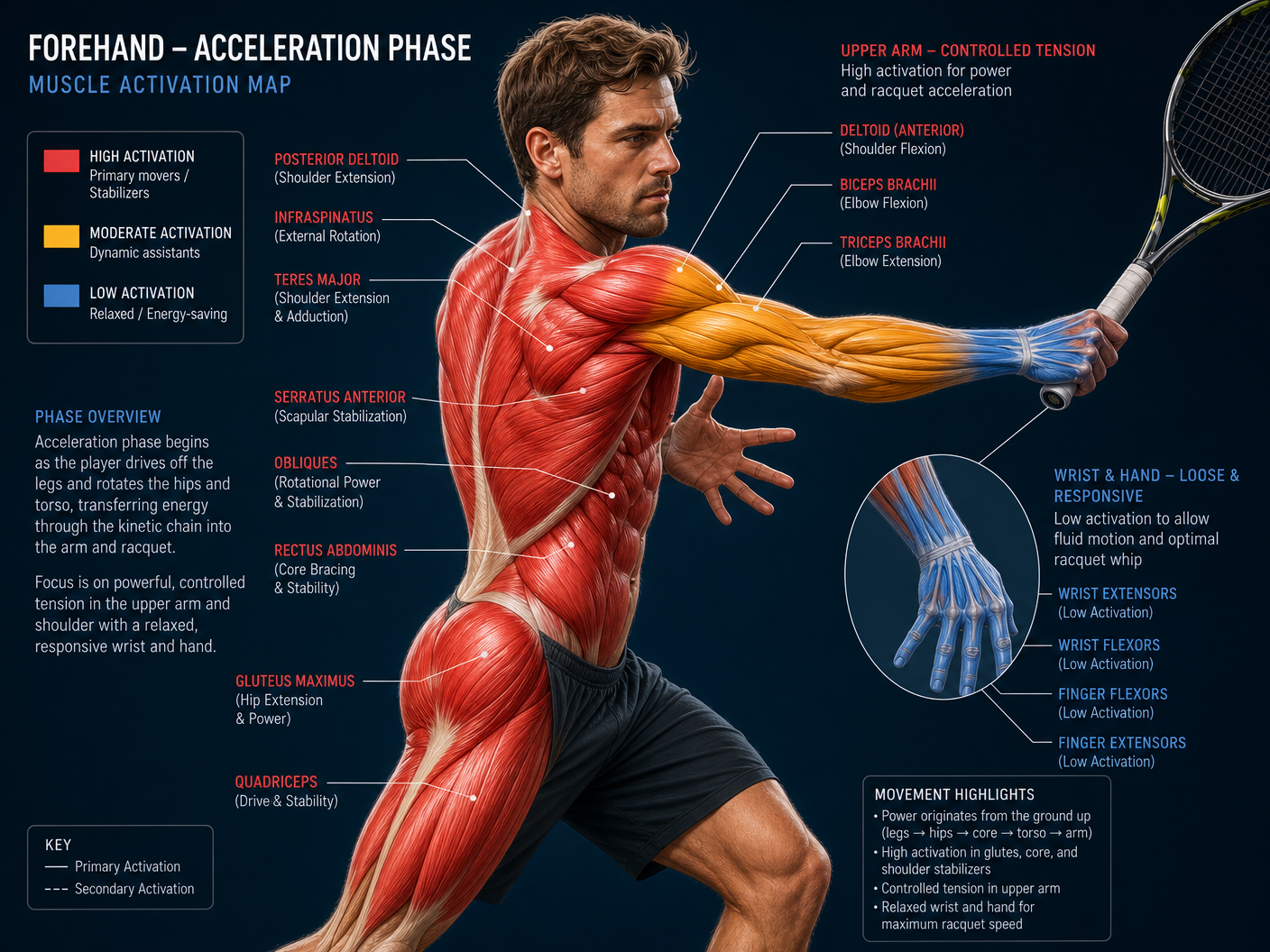
Figure 2: Muscle Activation Map during Acceleration Phase. This anatomical visualization shows high activation (red) in the primary movers and stabilizers, including the glutes, core, and shoulder stabilizers. The upper arm exhibits controlled tension (orange) to guide the racket, while the wrist and hand remain relaxed and responsive (blue) to allow for maximum racket whip and fluid motion.
Structural Comparison
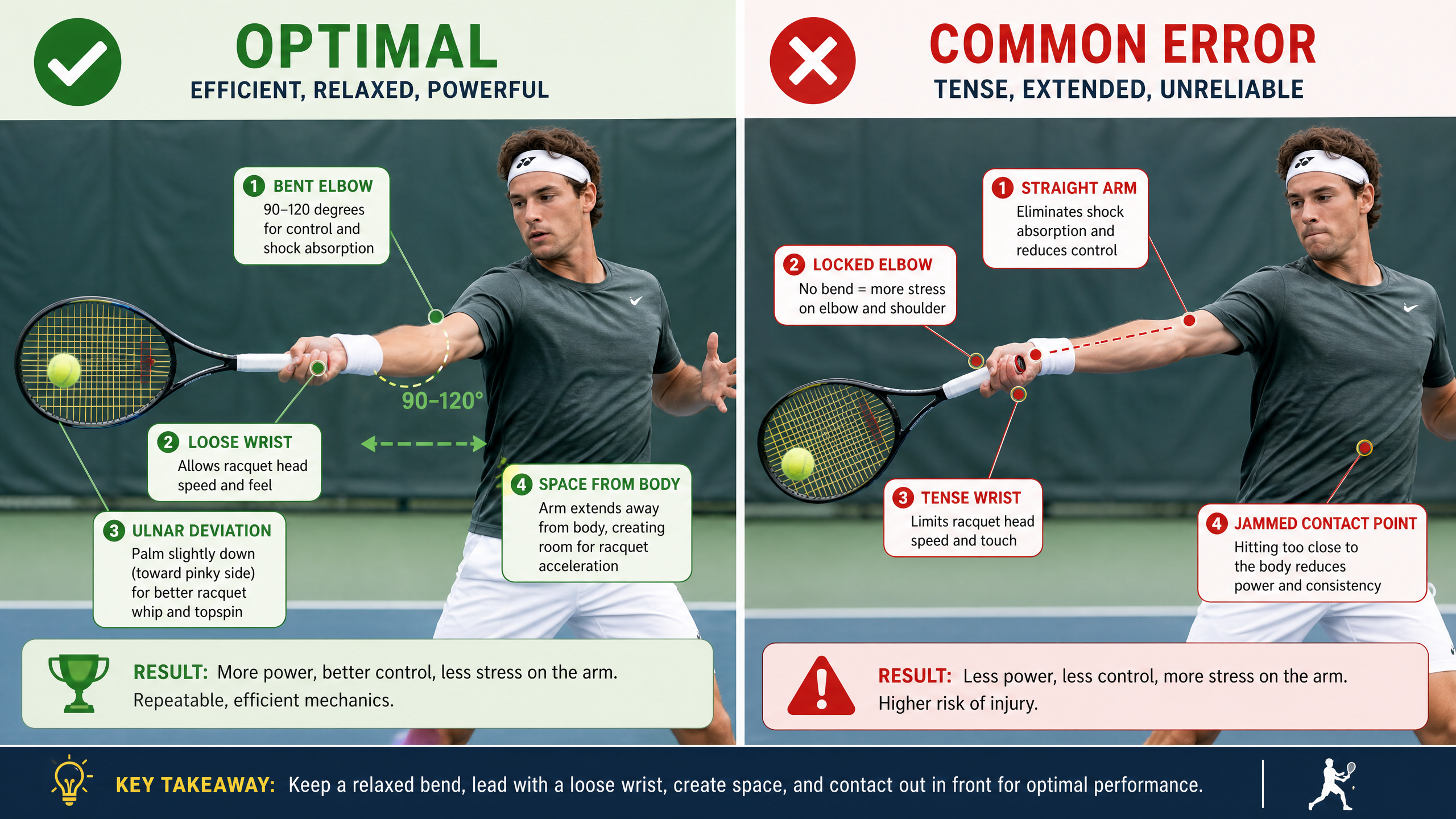
Figure 3: Optimal vs. Common Error Comparison. The left side shows the optimal configuration: a bent elbow (90-120 degrees), a loose wrist with ulnar deviation, and sufficient spacing from the body. This results in more power, better control, and less joint stress. The right side illustrates a common error: a tensed straight arm with a locked elbow and a jammed contact point, leading to reduced power, less control, and a higher risk of injury.
Structural Setpoints
1. Bent Elbow (C-Shape)
Description: The elbow is maintained in a relaxed bend, typically between 90 and 120 degrees, during the preparation and acceleration phases.
Anatomical Basis: - Elbow Joint: Flexion of 90-120 degrees. - Biceps Brachii & Brachialis: Moderate eccentric activation to maintain shape. - Shoulder Joint: Slight abduction to create spacing.
Function: This setpoint allows the arm to function as a mass-spring system, facilitating the storage and release of elastic energy. It also optimizes spacing between the racket and the body, creating a larger hitting zone and allowing for more fluid rotation.
Breakdown Consequences: - Loss of elastic energy loading. - Reduced hitting zone and increased jamming. - Excessive shock transfer to the elbow and shoulder joints.
Coaching Cue: "Maintain a relaxed 'C' shape with your elbow, like you're carrying a large basket."
2. Loose Wrist (Lag Position)
Description: The wrist remains soft and pliable, allowing the racket head to trail behind the hand during the forward swing.
Anatomical Basis: - Wrist Joint: Passive extension and slight supination. - Forearm Extensors: Stretched eccentrically (elastic loading). - Grip Pressure: Low (approx. 3/10).
Function: Creates the "lag" effect, which maximizes racket head speed through a late, explosive release. It also allows for better feel and the ability to generate spin by brushing the ball.
Breakdown Consequences: - Reduced racket head speed and power. - Loss of spin potential. - Increased forearm fatigue and risk of tennis elbow.
Coaching Cue: "Keep your wrist soft like a hinge, letting the racket head fall behind your hand."
3. Ulnar Deviation (Cocked Wrist)
Description: The wrist is tilted towards the pinky side, particularly during the preparation and racket drop phases.
Anatomical Basis: - Wrist Joint: Ulnar deviation. - Extensor Carpi Ulnaris (ECU): Engaged for stability. - Flexor Carpi Ulnaris (FCU): Engaged to support the alignment.
Function: In the serve, it contributes to the whip effect and increased racket speed. In the forehand, it allows the racket head to drop below the ball for topspin generation.
Breakdown Consequences: - Inefficient racket path and reduced spin. - Loss of the "whip" effect in the serve. - Increased risk of ulnar-sided wrist pain if unsupported.
Coaching Cue: "Cock your wrist slightly down towards your pinky as you prepare to swing."
Neurological Control Breakdown
Layer 1: High-Level Intent (Prefrontal & Motor Cortex)
The intent for this arm configuration is focused on efficiency and fluidity. The player consciously decides to use the arm as a conduit for energy generated from the legs and core, rather than as the primary power source. This involves a strategic choice to maintain a loose grip and a bent arm to maximize the "hitting zone" and "spin margin."
Layer 2: Execution & Refinement (Basal Ganglia & Cerebellum)
The execution layer initiates the learned sequence: leg drive → torso rotation → arm spring → racket whip. The cerebellum plays a critical role in real-time error correction, ensuring the wrist firms up automatically only at the split second of impact via the stretch reflex, rather than through a conscious squeeze. This layer also adjusts the arm's path based on the incoming ball's height and spin.
Layer 3: Automated Patterns (Central Pattern Generators & Spinal Cord)
With sufficient training, the "C-shape" and the "lag-explode" sequence become automated patterns. Central Pattern Generators (CPGs) help coordinate the rhythmic rotation and counter-rotation of the torso with the sequential acceleration of the arm segments. This allows the player to maintain the optimal arm shape without constant conscious monitoring.
Layer 4: Sensorimotor Feedback (Proprioceptors & Vestibular System)
Proprioceptors in the wrist and elbow provide continuous feedback on joint position and muscle tension. This is what coaches refer to as "feel." The vestibular system ensures balance is maintained throughout the dynamic rotation, allowing the arm to stay correctly spaced from the body even while moving at high speeds.
Performance Variations
Variation 1: Degree of Elbow Bend
While a bent arm is generally optimal, elite players like Roger Federer and Rafael Nadal are known for a straight-arm forehand at contact. This variation requires exceptional timing and footwork, as it moves the contact point further in front and narrows the hitting zone. However, it can offer a longer lever for even greater racket head speed for those with the necessary athletic prowess.
Variation 2: Follow-Through Style
Follow-throughs can vary from the traditional "over the shoulder" wrap to the "windshield wiper" finish common in modern topspin-heavy games. The key invariant is that the energy must be dissipated smoothly to protect the joints, regardless of the specific style.
Common Errors
Error 1: The "Locked Lever" (Straight Arm)
Description: Locking the elbow and tensing the arm throughout the swing.
Consequences: Reduced power, loss of spacing (jamming), and high shock transfer to the elbow and wrist, leading to injuries like tennis elbow.
Correction: Focus on shadowing the "C" shape and maintaining a 3/10 grip pressure.
Error 2: The "Death Grip" (Tense Wrist)
Description: Squeezing the racket handle too tightly, especially during the preparation and swing.
Consequences: Eliminates racket lag, reduces racket head speed, and kills the "feel" for the ball.
Correction: Practice the "shake test"—the wrist should be loose enough to wiggle if someone shakes your upper arm.
Training Framework and Development Progressions
Phase 1: Awareness and Positioning (Week 1-2)
- Shadowing the "C": Practice the backswing and forward swing without a ball, focusing on maintaining the 90-120 degree elbow bend.
- Grip Pressure Drills: Hit slow balls while consciously maintaining a 3/10 grip pressure.
Phase 2: Dynamic Integration (Week 3-4)
- Lag-and-Release Drills: Use a "drop feed" to practice letting the racket head lag behind the hand before releasing into the ball.
- Spacing Awareness: Use markers on the court to ensure the contact point is out in front and away from the body.
Phase 3: Performance Integration (Week 5+)
- Variable Ball Drills: Practice the configuration against different ball speeds and spins to refine the cerebellum's error-correction capabilities.
- Match Play Application: Focus on maintaining "loose wrist, controlled tension" during competitive points.
Conclusion
Optimal arm configuration in tennis is a sophisticated blend of structural stability and elastic flexibility. By treating the arm as a mass-spring system, maintaining a bent elbow, and allowing for a loose wrist with controlled tension, players can unlock significant power and spin while minimizing the risk of injury. This configuration moves the burden of control and stability up the kinetic chain to the larger, more robust muscle groups, allowing the arm and racket to act as a highly efficient final segment for energy transfer. Understanding the neurological and biomechanical principles behind these mechanics is essential for any player or coach looking to master the modern game.
References
- User Coaching Notes. Arm Configuration in Stroke. (2026).
- Oh, H., Lewis, O., Yousuf, A., & Kim, S. (2010). Simulation of a Tennis Player's Swing-Arm Motion. International Journal of Modern Engineering. 3
- Glynn, J. A. (2007). An investigation of elbow loading in one-handed tennis backhand groundstrokes using computer simulation. 8
- Tennis-Warehouse Forum. The role of the wrist: feels like a breakthrough for my tennis. 9
- Israel, J. S., et al. (2023). Wrist Motion Assessment in Tennis Players using Three-Dimensional Kinematics. PMC. 10
- Cash, P. (2019). Tennis Forehand Technique: Straight Arm vs Bent Arm. 11
- Manus AI. Neurological Control Framework for Tennis Biomechanics. (2026).
Document Version: 1.0
Last Updated: May 30, 2026