Tennis Forehand Biomechanics: A Visual Analysis
Author: Manus AI Date: June 1, 2026
1. Introduction
The tennis forehand is a complex, powerful stroke that relies heavily on efficient biomechanical sequencing and rotational energy transfer. This report provides a visual breakdown of the forehand stroke, integrating principles derived from the discus throw analogy and internal martial arts concepts (Mingmen, Dantian, and Center of Gravity). Each phase is illustrated with a high-quality image and detailed biomechanical explanations.
2. The 5 Phases of the Tennis Forehand
2.1 Phase 1: Unit Turn & Preparation
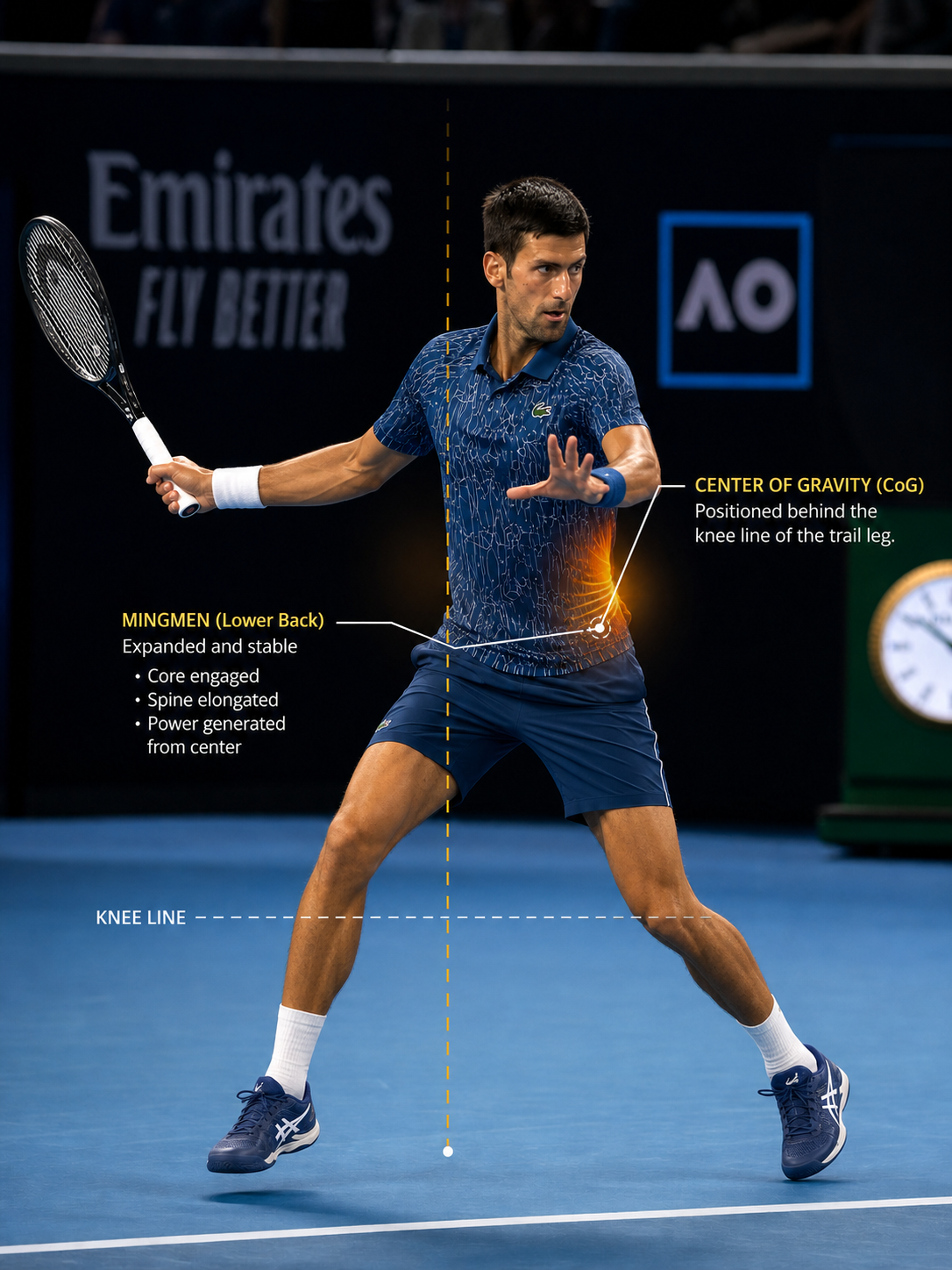
This initial phase sets the foundation for the entire stroke. The player turns their shoulders and hips as a unit, preparing the body for the subsequent loading. A key biomechanical checkpoint here is maintaining the Center of Gravity (CoG) behind the knee line of the trail leg. This prevents the player from falling forward and allows for a powerful weight transfer later in the stroke. Internally, the Mingmen (lower back) should feel expanded and stable, indicating proper spinal alignment and readiness for elastic loading.
2.2 Phase 2: Loading & Lateral Tilt
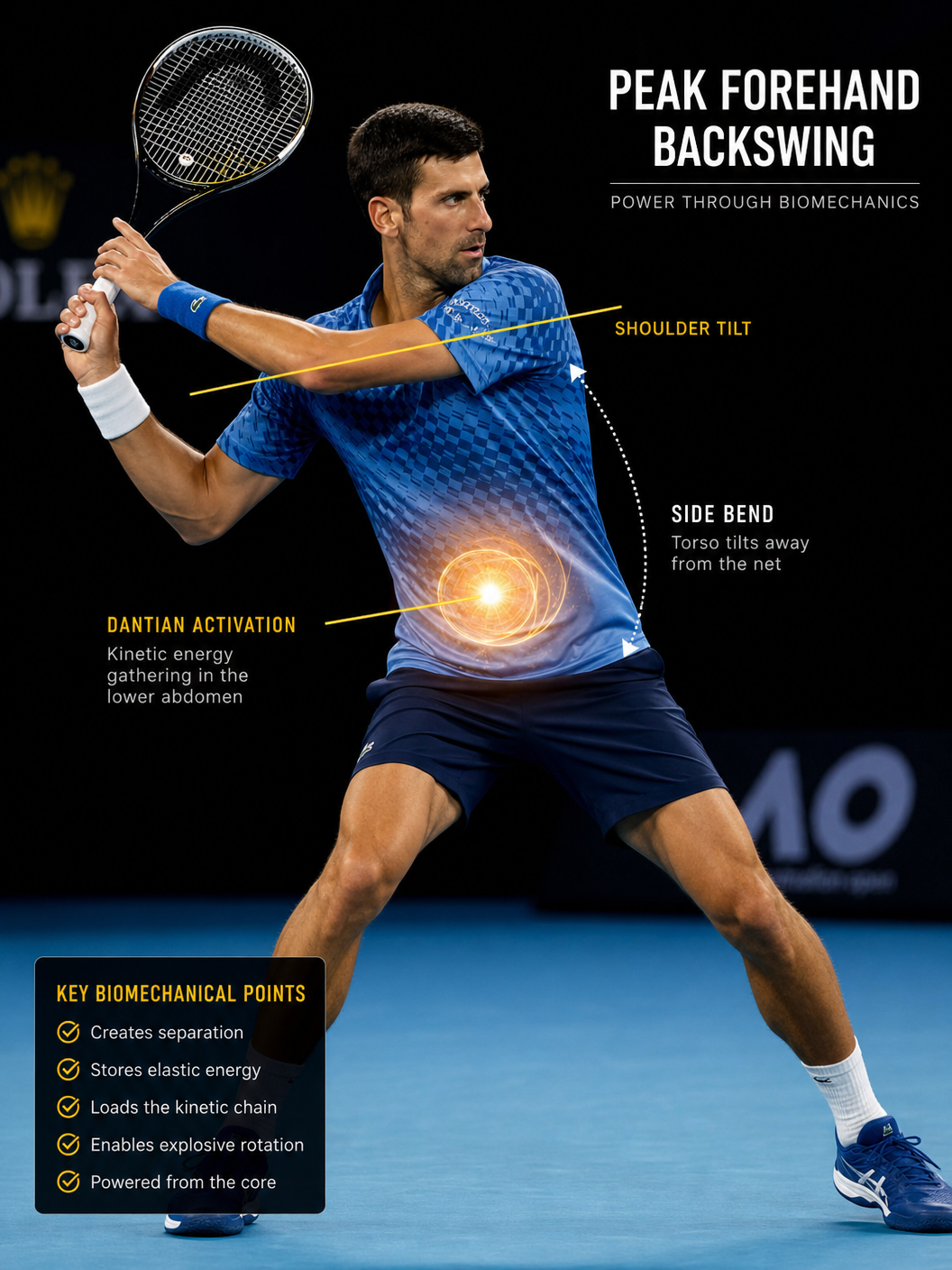
As the racket moves into the backswing, the body loads energy. A crucial element is the side bend at the waist, a lateral flexion of the torso away from the net. This tilt helps maintain the spine angle, keeps the head behind the ball, and creates a "bow" shape, similar to the discus thrower's preparation. Simultaneously, the Dantian (lower abdomen) begins to gather and build internal pressure, signaling the core's engagement.
2.3 Phase 3: The Hip Bump & Lag
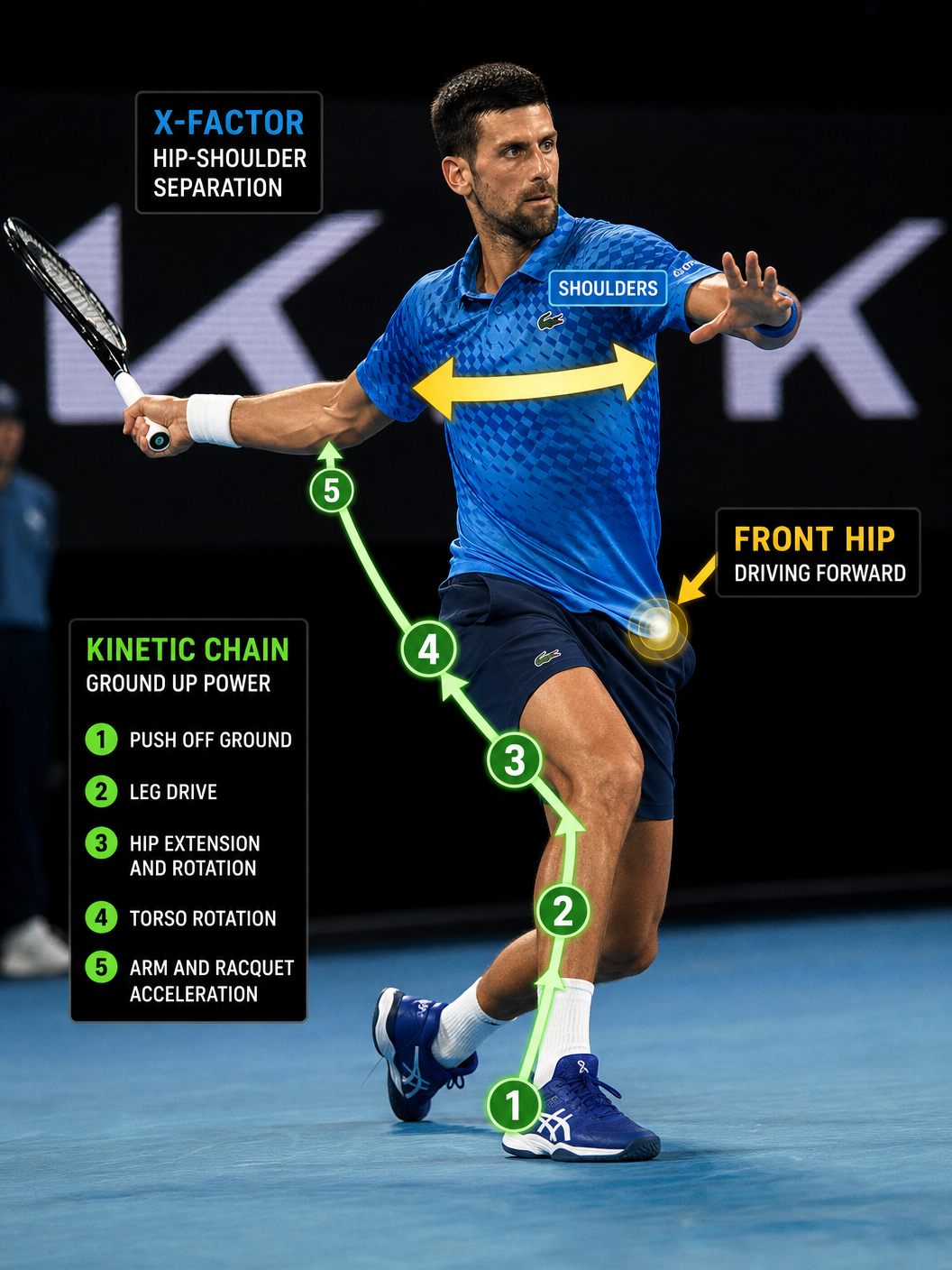
This is a critical transition phase where the hips initiate the forward movement before the upper body and racket. The hip bump involves a sharp, linear drive of the front hip towards the ball. This action creates significant hip-shoulder separation (also known as the X-factor), stretching the core muscles and storing elastic energy. The racket, due to inertia, lags behind the hand, maximizing the lever arm and setting up for explosive acceleration. This phase is driven by the Dantian's projection, leading the kinetic chain.
2.4 Phase 4: Contact & Dynamic Block
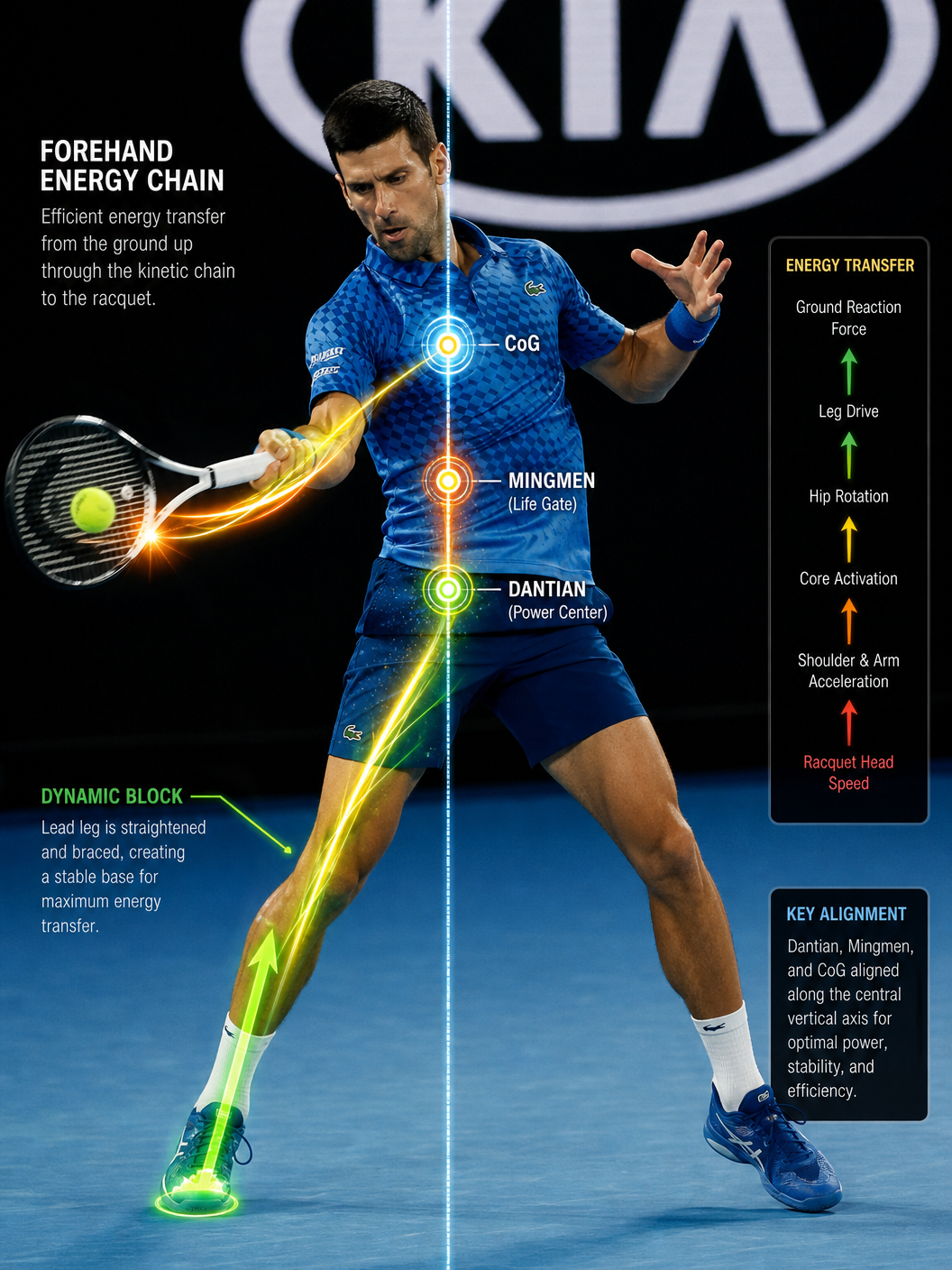
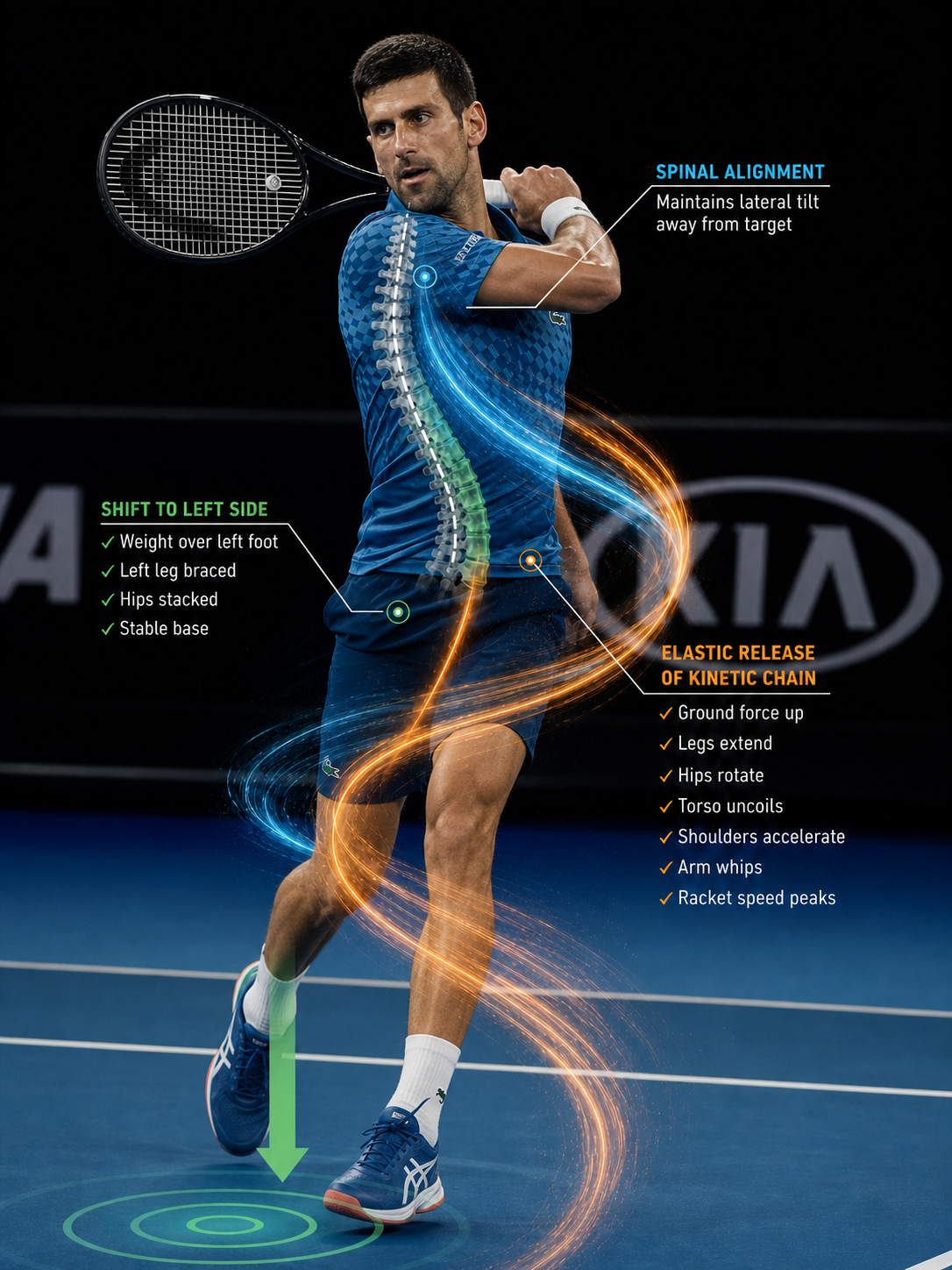
At the point of contact, the lead leg straightens and braces, forming a dynamic block. This action rapidly decelerates the lower body, transferring all accumulated kinetic energy up through the torso, shoulder, and arm into the racket. The efficient alignment of Dantian, Mingmen, and CoG along a central vertical axis ensures optimal power transfer and stability. The ball is struck with maximum racket head speed, generated from the ground up through the kinetic chain.
2.5 Phase 5: Follow-Through & Release
After contact, the body continues its rotation, allowing for a full and relaxed follow-through. The weight shifts entirely to the lead side, but the spine maintains a lateral tilt away from the target, preventing collapse and facilitating recovery. This shift to the left side (for a right-handed player) is a controlled release of the stored elastic energy, ensuring a smooth deceleration of the racket and body, and preparing the player for the next shot.
3. Conclusion
The tennis forehand, when executed with optimal biomechanics, mirrors the powerful rotational mechanics of the discus throw. By focusing on key structural setpoints—such as the lateral side bend, maintaining CoG behind the knee line, initiating with a hip bump to create lag and hip-shoulder separation, and utilizing a dynamic block—players can unlock significant power and efficiency. Integrating these external movements with internal concepts like Dantian and Mingmen allows for a holistic understanding of the stroke, leading to a more fluid, powerful, and injury-resistant game.
References
[1] PubMed Central. "A kinematic comparison of the overhand throw and tennis serve in tennis players: How similar are they really?" https://pmc.ncbi.nlm.nih.gov/articles/PMC2577481/