Biomechanics Analysis Report: Connected Tension — Compact Power System
Stroke/System: Integrated Compact Power (Tensegrity, Volley, Footwork, Rotation)
Subject: Biomechanical Analysis using Neurological Control Theory
Date: May 30, 2026
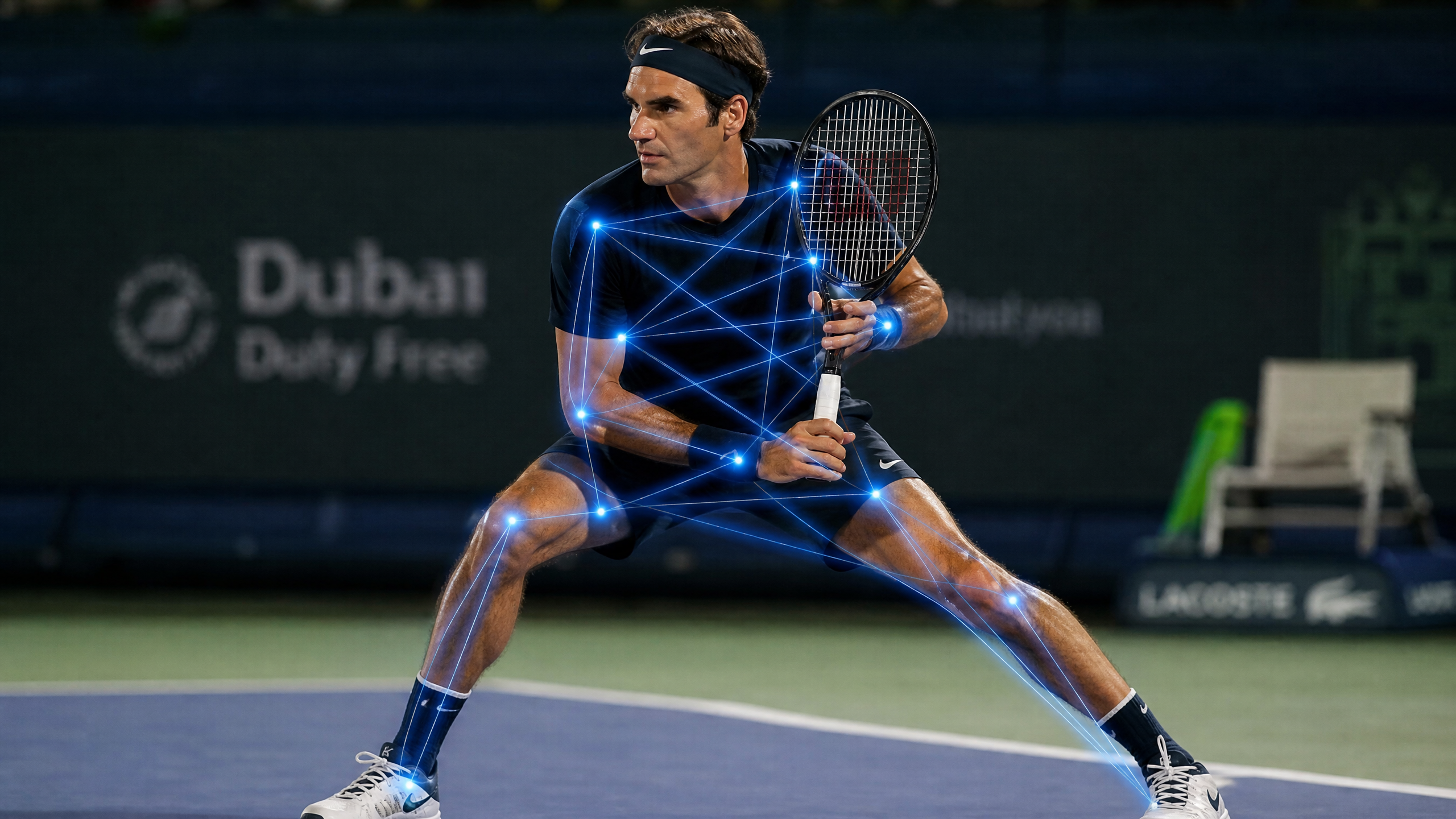
Executive Summary
The "Connected Tension — Compact Power System" represents a paradigm shift from traditional "swing-based" tennis to a "loading-based" structural system [1]. By integrating the architectural principle of Tensegrity [2] with continuous Figure-8 rotation [3] and asymmetrical footwork [1], this system allows for high-velocity output with minimal backswing.
The core of the system lies in pre-tensioning the body's fascial lines (the "Cradle") [1] and using a ground-reaction "hop" to trigger a rapid kinetic chain [1]. This report breaks down the neurological orchestration and biomechanical setpoints that enable this "effortless power," providing a framework for both elite performance and sustainable movement.
Introduction
Modern tennis is increasingly defined by time-compression. As ball speeds increase, the traditional large, loopy backswing becomes a liability. The "Connected Tension" system solves this by treating the human body not as a series of isolated levers, but as a unified tensegrity structure [2].
This analysis applies Neurological Control Theory [4] to explain how the Central Nervous System (CNS) can automate complex rotations and maintain structural integrity under high-speed conditions. We move beyond simple "how-to" coaching cues to explore the "why" of the kinetic chain, focusing on the interplay between the Mingmen (back power gate) [5], Dantian (movement hub) [5], and the rhythmic Salsa-inspired Figure-8 rotation [1, 3].
Foundational Concepts
1. Bio-Tensegrity: The "Connected & Tension" Principle
Traditional biomechanics often views the body as a "column" (compression-based). This system adopts Tensegrity (Tensional Integrity), where the body is a network of "islands" of compression (bones) floating in a "sea" of continuous tension (muscles/fascia) [2, 6]. - The Load: By pressing on the racquet handle and moving the unit to the right side, the player pre-loads the fascial lines [1]. - The Cradle (Om Dong Dua Vot): The shoulders move "inside" (protraction) while elbows move "out," creating a stable, tensed frame. This "cradle" holds the racquet close to the center of mass, reducing the moment of inertia and allowing for faster rotation [1].
2. Compact Momentum: The Hop and Hip Engine
Power is generated through a "brief takeback" that serves as a trigger rather than a source [1]. - The Hop: A small, reactive hop creates a sudden Ground Reaction Force (GRF) [7]. This isn't for height but for "loading" the elastic energy in the lower limbs [1]. - The Hip Bump: The kinetic chain is initiated by the hip moving forward before the arm [1, 8]. This creates a "lag" effect, where the upper body is pulled into the shot by the lower body's momentum [1].
3. Asymmetrical Footwork: The Anchor and Adjuster
The system rejects parallel footwork in favor of an asymmetrical model [1]. - The Anchor: One foot is planted flat, providing a stable pivot and sensory feedback to the vestibular system [1]. - The Adjuster: The other foot stays on the toes, allowing for rapid micro-adjustments [1]. - The Kickback: During the hit, the adjuster foot "kicks back." This acts as a dynamic counterbalance, allowing the hips to rotate fully without the player losing their center of gravity [1].
4. Continuous Figure-8 Rotation (Salsa Rhythm)
Movement is never "start-stop." It follows a continuous infinity loop (Figure-8) mapped to four corners of the torso [3, 9]. - The Rhythm: Inspired by Salsa dancing, the rotation keeps the upper body in a state of "Song" (elastic relaxation) [5]. - The Mapping: Shoulders trace a 1→4→2→3 path, ensuring that the uncoil of one shot is the preparation for the next [1].
Neurological Control Breakdown
Layer 1: High-Level Intent (Prefrontal & Motor Cortex)
The player's intent shifts from "hitting the ball" to "maintaining the cradle." The conscious mind focuses on the tactical objective (e.g., deep volley, angled cross) while the "Intent" layer maintains the pre-tensioned state [4].
Layer 2: Execution & Refinement (Basal Ganglia & Cerebellum)
The Basal Ganglia selects the "Compact Power" motor program [4]. The Cerebellum uses real-time feedback from the "Anchor" foot and the "Cradle" tension to adjust the racquet face angle [4]. For low balls, it commands a "tip down" orientation; for high balls, a "tip up" orientation, all while keeping the face closed [1].
Layer 3: Automated Patterns (Central Pattern Generators & Spinal Cord)
The Figure-8 rotation is offloaded to Central Pattern Generators (CPGs) in the spinal cord [4]. Once the rhythm is established, the torso rotates with minimal cortical input, much like the rhythmic gait of walking or dancing [1, 4]. This reduces cognitive load during high-speed rallies [4].
Layer 4: Sensorimotor Feedback (Proprioceptors & Vestibular System)
- Proprioception: The "press on the handle" provides constant feedback about racquet orientation [4].
- Vestibular: The "Anchor" foot provides a clear vertical reference, allowing the brain to maintain balance even during the explosive "kickback" motion [4].
Visual Analysis
Kinetic Chain Integration
 Figure 1: The kinetic chain for a compact groundstroke. Power originates from the Ground Reaction Force (1), is triggered by the Hip (2), transmitted through the Torso (3), and finally released through the Racquet Whip (4).
Continuous Figure-8 Rotation
 Figure 2: The Salsa-inspired Figure-8 torso rotation. The continuous infinity loop (1→4→2→3) ensures that the uncoil of one shot flows seamlessly into the preparation of the next, maintaining elastic momentum.
Footwork: Anchor vs. Error
 Figure 3: Comparison between the 'Anchor & Adjuster' model and common parallel footwork errors. The anchor provides a stable axis, while the kickback acts as a dynamic counterbalance.
Structural Setpoints
1. The Tensegrity Cradle (Om Dong Dua Vot)
Description: Shoulders protracted (moving inside), elbows slightly flared, racquet held in front of the chest [1]. Anatomical Basis: - Serratus Anterior: Engaged to pull shoulders forward [1]. - Pectoralis Minor: Stabilizes the "inside" shoulder position [1]. - Wrist Extensors: Pre-tensioned by pressing the handle [1]. Function: Creates a single, unified unit that moves with the torso, eliminating the "loose arm" error [1].
2. Mingmen Expansion (The Back Gate)
Description: The lower back (L2-L3) is "opened" or flattened, avoiding lumbar collapse [5]. Anatomical Basis: - Transverse Abdominis: Engaged for core stability [5]. - Psoas Major: Lengthened to allow hip-shoulder separation [5]. Function: Acts as a "spring" that stores elastic energy during the unit turn and releases it during the forward hip move [5].
3. The Asymmetrical Base
Description: Lead foot flat (Anchor), rear foot on toes (Adjuster) [1]. Anatomical Basis: - Gastrocnemius/Soleus: Loaded on the adjuster foot [1]. - Gluteus Medius: Stabilizes the anchor hip [1]. Function: Provides a stable rotational axis while allowing for a dynamic "kickback" counterbalance [1].
Performance Variations: Ball Height Handling
| Ball Height | Racquet Face | Racquet Tip | Biomechanical Action |
|---|---|---|---|
| Low Ball | Closed | DOWN | Steep brush-up using the "Hop" for lift. |
| High Ball | Closed | UP | Forward drive keeping the "Cradle" intact to avoid hitting flat. |
Common Errors
1. The "Punch" Volley
- Description: Trying to hit the volley with a separate arm motion [1].
- Consequence: Loss of stability, "pulling away" from the ball, inconsistent contact [1].
- Correction: Return to the "Cradle." The power comes from the torso rotation and the pre-tensioned "impulse." [1]
2. Dead Pelvis
- Description: Hips remaining static while the arm swings [1].
- Consequence: "Arming" the ball, reduced pace, high injury risk to the elbow [1].
- Correction: Focus on the "Hip moves forward" cue. The hip must trigger the rotation [1].
3. Linear Reset
- Description: Stopping the body after a shot and resetting to a stiff neutral [1].
- Consequence: Loss of momentum, slower recovery [1].
- Correction: Apply the Salsa Figure-8. The finish of the follow-through should flow directly into the next preparation [1].
Training Framework
Phase 1: Structural Awareness (Week 1-2)
- Drill: "Press and Hold." Stand in the cradle position, pressing the handle. Have a partner try to move the racquet; it should move the whole body [1].
- Goal: Feel the "Connected & Tension" state [1].
Phase 2: The Rhythm Engine (Week 3-4)
- Drill: "Salsa Shadows." Perform slow Figure-8 rotations without a racquet, mapping the 1-4-2-3 corners [1].
- Goal: Automate the continuous rotation pattern [1].
Phase 3: Dynamic Loading (Week 5+)
- Drill: "Hop-Hip-Hit." Focus on the sequence: Small hop -> Hip forward -> Compact strike [1].
- Goal: Integrate the ground-up kinetic chain [1].
Conclusion
The "Connected Tension — Compact Power System" is a sophisticated integration of internal arts (Mingmen/Dantian) and modern biomechanics. By prioritizing structural integrity (Tensegrity) over muscular effort, players can achieve "heavy" shots with minimal physical strain. The key is to trust the preload—the pre-tensioned state that holds the impulse ready to be released by the hip and the hop.
References
- [User Provided Document] (2026). Tennissystemanalysis.md.
- Myers, T. (2014). Anatomy Trains: Myofascial Meridians for Manual and Movement Therapists. Churchill Livingstone.
- Broudy, J. (2022). The Figure 8 "Magic Move" of the Natural Athlete. SportsEdTV. Available at: https://sportsedtv.com/blog/The-Figure-8-Magic-Move-of-the-Natural-Athlete-tennis
- Kandel, E. R., Schwartz, J. H., & Jessell, T. M. (2013). Principles of Neural Science (5th ed.). McGraw-Hill.
- [User Provided Document] (2026). Mingmen-Dantian and Center of gravity.md.
- Serola, R. (2022). Tensegrity: The Interplay Between Muscles and Ligaments. Serola Biomechanics. Available at: https://www.serola.net/tensegrity-the-interplay-between-muscles-and-ligaments/
- [YouTube Video] (2017). Ground Reaction Force In Tennis Demonstration #1. Available at: https://www.youtube.com/watch?v=cPKUosWplHw
- [Facebook Post] (2018). Proper technique matters for better performance and results. Available at: https://www.facebook.com/groups/1340630926008388/posts/1867774669960675/
- [YouTube Video] (2026). The Figure 8 Core Rotation of The Effortless Strokes. Broudy Tennis. Available at: https://www.youtube.com/watch?v=1GDiECDJIeg