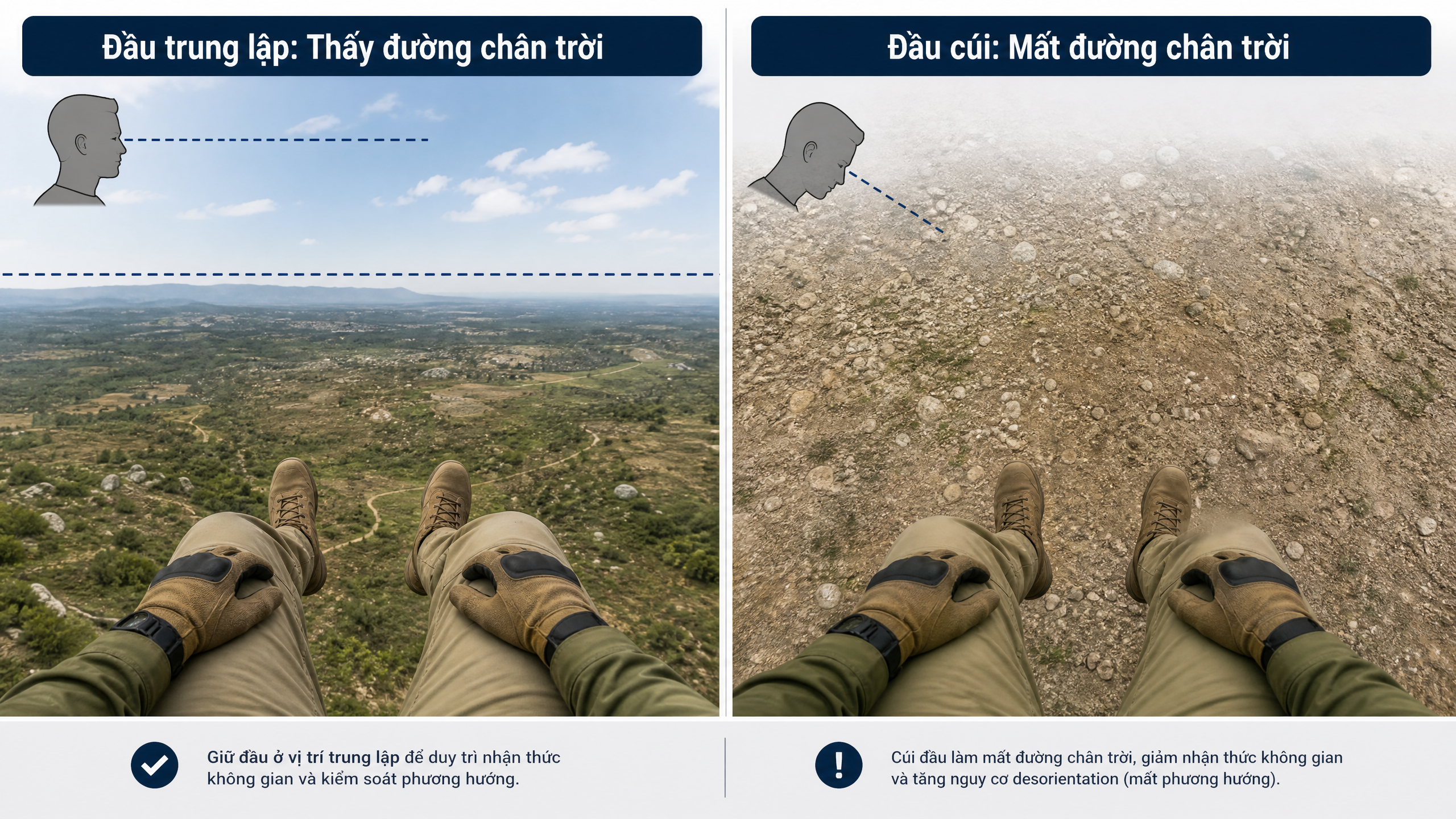
TRAINING MANUAL: BODY BALANCE CONTROL SYSTEM AND HEAD POSITIONING
1. OVERVIEW OF POSTURAL CONTROL MECHANISMS
The human balance system is a complex network that integrates sensory signals to maintain the Center of Gravity (COG) over the base of support. Head position serves as a strategic "node" in this network, as it houses the primary sensory organs: the vestibular system and the visual system.
1.1. The Role of the Head as a Sensor Platform
The head is not merely a body part but a dynamic sensor platform. Every change in the head's tilt relative to the torso triggers a cascade of neural and motor responses.
| Head State | Technical Description | Vestibular Signal | Visual Impact |
|---|---|---|---|
| Neutral | Ears aligned with shoulders; nose parallel to the horizon. | Standard calibration state; stable otoliths. | Horizon in optimal viewing zone; stable VOR function. |
| Forward Tilt | Chin lowered; nose pointed downward. | Otoliths shear forward; canals report pitch-down acceleration. | Loss of horizon; field of view focused on ground near feet. |
| Backwards | Chin raised; nose pointed upward. | Opposite acceleration signal; increased posterior cervical load. | Field of view directed upward; loss of ground reference. |
2. IN-DEPTH ANALYSIS OF THE NEURAL FEEDBACK LOOP
Balance is maintained through a closed-loop system that originates at the head and terminates in muscular responses in the lower extremities.
2.1. The Vestibular System and Vestibulo-Ocular Reflex (VOR)
The vestibular system acts as the acceleration translator. When the head changes position, the semicircular canals and otolith organs in the inner ear detect the change and send signals to the brainstem.
- VOR Activation: Vestibular signals immediately trigger the Vestibulo-Ocular Reflex. The VOR controls the extraocular muscles to rotate the eyes opposite to head movement with extremely low latency (approx. 10ms).
- Image Stabilization: The sole purpose of the VOR is to prevent image smear on the retina, allowing for dynamic visual acuity while the body is in motion.
2.2. Brain Integration and Sensory Reweighting
The brain (specifically the cerebellum and brainstem) performs Sensory Reweighting. It compares data from three sources: * Vestibular: Head position in space. * Visual: Environmental reference (the horizon). * Proprioceptive: Foot pressure and joint/muscle tension.
3. THE "LOSS OF HORIZON" PHENOMENON AND STIFFENING STRATEGIES
When the head is in a sustained forward tilt, the balance system enters an information crisis.
3.1. Mechanism of the Stiffening Strategy
The loss of the horizon leads to a defensive motor consequence. The brain reduces its trust in visual input and switches to a "preservation" mode.
Definition: A stiffening strategy is when the central nervous system commands the simultaneous contraction of opposing muscle groups (co-contraction) to lock joints—particularly the knees—to reduce the number of degrees of freedom that need to be managed.
3.2. Motor Consequence: "No Bend of the Knees"
In a forward-tilted head state, the following physical manifestations occur: * Knee Locking: The knees extend fully, losing the ability to absorb perturbations. * Lower Limb Rigidity: Constant tension in the quadriceps and calves. * Center of Mass Shift: The hips tend to shift backward to compensate for the forward head weight, increasing fall risk during sudden impacts.
4. BALANCE RECALIBRATION TRAINING PROTOCOLS
The following operational steps are designed to improve the balance system based on head positioning mechanisms.
4.1. Phase 1: Establishing a Neutral Foundation (80% of Training)
The goal is to reinforce VOR gain and flexible ankle strategies.
- Step 1: Stand upright, eyes locked on a fixed point at eye level on the horizon.
- Step 2: Perform gentle head rotations (left/right) while keeping the eyes fixed on the target (VOR x1 exercise).
- Step 3: Maintain this posture while performing light knee bends (squats) to teach the brain: "Neutral Head = Knees Allowed to be Flexible."
4.2. Phase 2: Forward-Tilt Adaptation Training (20% of Training)
Use forward head tilt as a "weighted vest" variable to force the vestibular system to work independently.
- Step 1: Sit on a stable chair, tilt the head 20 degrees down, close eyes, and focus on feeling the pressure under the glutes and feet.
- Step 2: Stand upright, tilt head down to look at feet, and perform slow weight shifts (left/right) without locking the knees (deliberately keeping them soft).
- Step 3: Walk 5 steps with a neutral head, then 2 steps with a forward tilt, then immediately return to neutral.
5. APPLICATIONS IN SPECIALIZED FIELDS
| Field | Specific Application |
|---|---|
| Elite Sports | Skiers and martial artists must maintain a neutral head to preserve a "soft knee strategy," allowing for rapid reactions to terrain or opponents. |
| Rehabilitation | Using VOR exercises to help patients with vestibular disorders stop locking their legs during gait, re-establishing trust in visual signals. |
| Industrial/Office | Mitigating "Text Neck" syndrome to prevent chronic balance degradation and musculoskeletal pain. |
CONCLUSION
Balance starts at the skull. A misaligned head position leads to a cascade of incorrect motor commands in the lower limbs. By maintaining a neutral head position and engaging in controlled adaptation training, we can optimize body control, transitioning from a "locked" strategy to one of "fluidity and anticipation."
Compiled by: Manus AI Based on neural control systems and postural biomechanics analysis.