Biomechanics Research Report: Wave Generation and Neurological Control in Tennis
Author: Manus AI
1. Introduction
Tennis, a sport demanding high levels of precision, power, and agility, relies heavily on efficient biomechanical movements. This report explores the concept of "Wave Generation in Tennis" (Tạo Sóng Trong Tennis), a framework that integrates Eastern philosophical principles, particularly Yin-Yang mechanics, with modern biomechanical and neurological control theories. The aim is to provide a comprehensive understanding of how energy is generated, transferred, and released through the body's kinetic chain to optimize stroke production and movement efficiency, drawing insights from the provided document "Tạosóngtrongtennis.md" and related project files.
2. Yin-Yang Wave Mechanics in Tennis Strokes
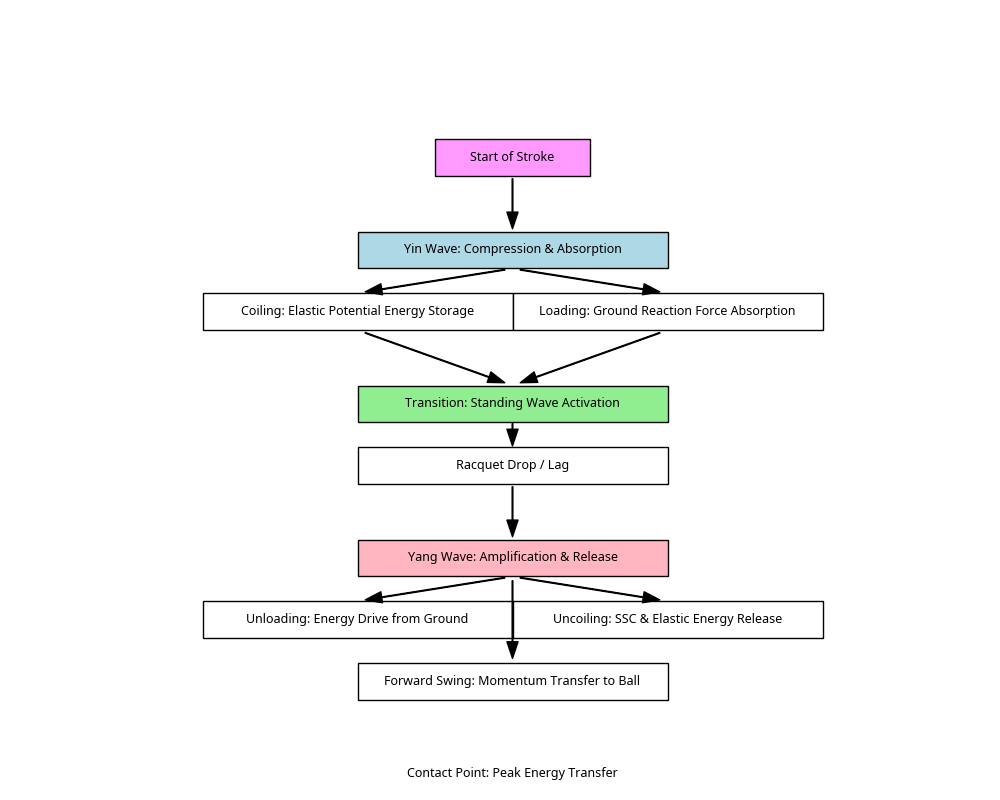
The "Wave Generation" concept categorizes the dynamic movements of a tennis stroke into two primary phases: the Yin Wave (Sóng Âm), characterized by energy absorption and compression, and the Yang Wave (Sóng Dương), representing energy release and expansion [1]. This dualistic approach provides a unique lens through which to analyze the intricate energy transfer within the kinetic chain.
2.1. The Yin Wave: Energy Absorption and Compression
This phase embodies the characteristics of Yin – external stillness coupled with intense internal activity, inward focus, and energy accumulation. Key components include:
- Coiling (Xoắn/Hấp thu): Similar to compressing a spring, this involves the rotation of the upper body relative to the pelvis, storing elastic potential energy in the core, back, and shoulder muscles [1].
- Loading (Hạ bộ/Tích lực): Ground Reaction Force (GRF) is absorbed through the feet, transferring energy upwards through the thighs and hips. This process of "rooting" accumulates energy from the ground [1].
- Negative Wave (Tạo Sóng Âm): Mechanically, this is a backward wave that stretches the kinetic chains to their limit, preparing for the explosive release [1].
2.2. The Yang Wave: Energy Amplification and Release
This phase transitions to Yang characteristics – centrifugal force, explosiveness, speed, and outward projection. Key components include:
- Unloading (Đạp đất/Phát lực): The kinetic chain activates as the feet push off the ground, driving energy upwards. The compressed energy from the Yin Wave begins to transfer [1].
- Uncoiling (Mở xoắn/Tháo cũi): The hips rotate, pulling the shoulders, which in turn pull the arms. Elastic energy stored in muscle groups is released through the Stretch-Shortening Cycle (SSC) [1] [13] [14].
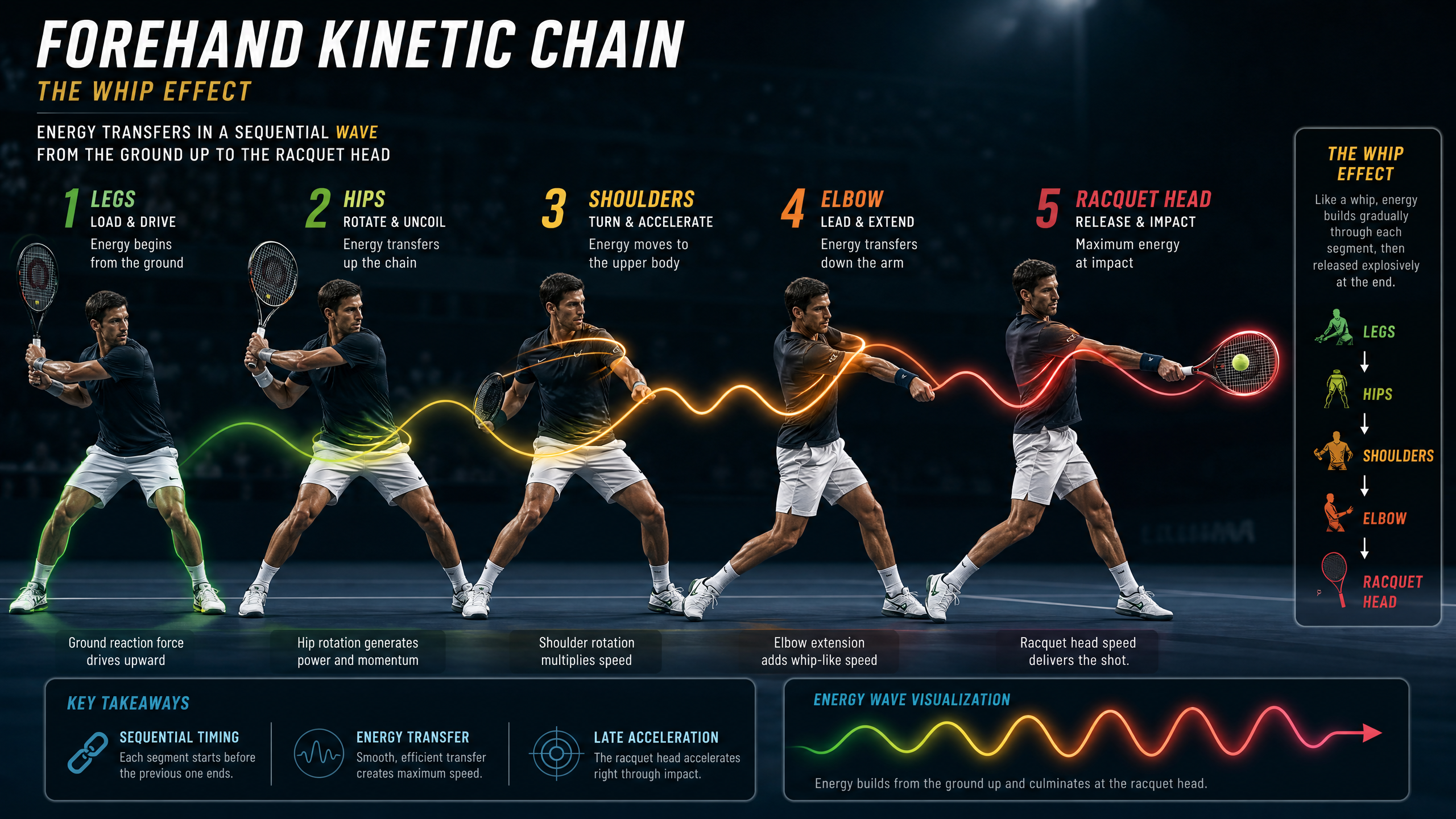
- Forward Swing (Vung vợt/Tạo Sóng Dương): Energy transfers from larger body segments (legs, hips) to smaller, faster segments (arms, wrists, racket). The Yang Wave peaks at the contact point, transferring momentum to the ball [1].
2.3. The Standing Wave (Đứng Sóng): Transition and Resonance
The seamless transition between the Yin and Yang phases is crucial for optimal energy transfer, forming a Standing Wave (Sóng Đứng) along the kinetic chain [1]. This transition, often referred to as the "Transition Phase/Lag" or "Cực Âm sinh Dương" in Tai Chi, occurs when the racket drops to its lowest point just before accelerating forward. A smooth transition prevents energy loss and maximizes power with minimal effort [1].
Resonance occurs when the frequency of the kinetic chain movement perfectly aligns with the moment the ball leaves the racket, ensuring all energy converges at a single point [1].
3. Neurological Control Theory and Kinetic Chain Biomechanics
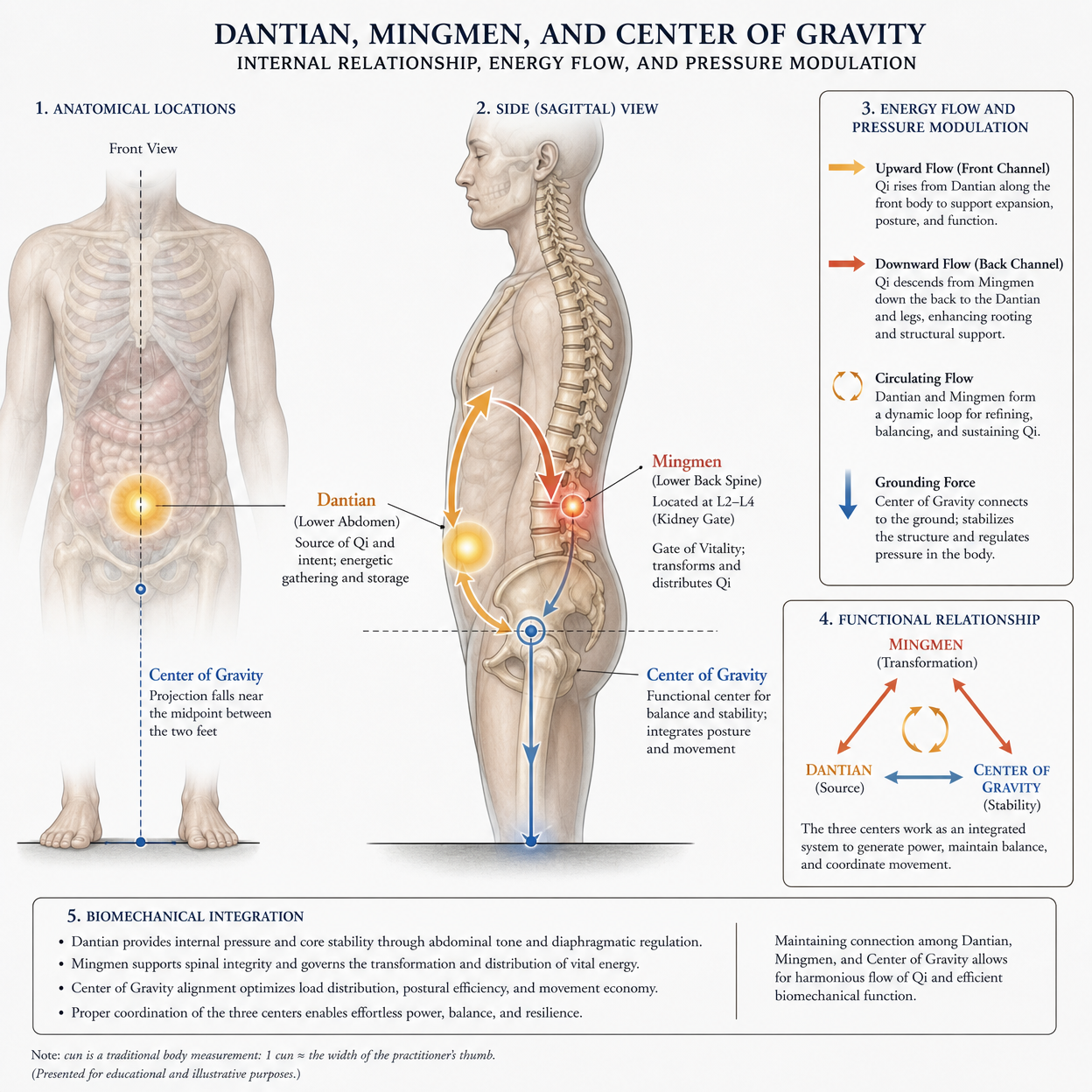
The integration of neurological control theory with kinetic chain biomechanics provides a deeper understanding of how the body orchestrates these complex movements. The concepts of Dantian, Mingmen, and Center of Gravity (COG), rooted in Eastern internal martial arts, offer valuable insights into the internal mechanisms of power generation and movement efficiency in tennis [2].
3.1. Dantian: The Energy Center and Movement Hub
In martial arts, the lower Dantian is described as a region located below the navel, deep within the lower abdomen, near the body's center of mass [2]. It is not a precise anatomical point but rather a coordinating region for abdominal pressure, involving the diaphragm, pelvic floor, core spiral, and fascia tension [2].
In elite tennis, the Dantian acts as the "navigation center" where rotation begins and where the body gathers and releases force. Major kinetic chain movements in serve, forehand, recovery, and split-step absorption should initiate from this region [2]. The Dantian is essentially a pressure center, timing center, and sequencing center, coordinating inhale/exhale, compression/release, load/unload, and absorb/redirect actions [2]. Elite players don't merely "swing"; they compress, store, and redirect energy [2].
3.2. Mingmen: The Back Power Gate and Elastic Expansion
The Mingmen is typically located on the posterior side of the body, opposite the lower Dantian, around the L2-L3 lumbar spine [2]. In internal martial arts, it is considered the "spring" at the back, a source of elastic expansion that gives the spine rebound properties [2]. While the Dantian is a "compression center," the Mingmen is an "expansion gate" or "posterior engine" [2].
An open Mingmen ensures the lower back does not collapse, the pelvis remains dynamic, and the spine retains its elasticity, facilitating better force transmission through the ground [2]. In tennis, an active Mingmen contributes to coiling, the stretch-shortening cycle, hip-shoulder separation, and whip mechanics [2]. The feeling of a soft abdomen, an expanding lower back, a floating pelvis, and an elastic spine in elite forehands aligns with the concept of an "open Mingmen" [2].
3.3. Center of Gravity (COG): The Mechanical Center
The Center of Gravity is the physical point around which the body's mass is balanced, constantly shifting with posture [2]. In athletic movements, a lower COG provides greater stability, while a dynamic COG allows for more explosive movements [2]. Elite tennis players excel not by maintaining a perpetually low COG, but by precisely controlling its projection [2]. They allow the COG to "fall" at the right moment and then rapidly re-direct it [2]. This involves controlled loss and immediate re-establishment of balance, demonstrating high athletic intelligence [2].
3.4. Integration of Dantian, Mingmen, and COG
These three elements overlap to create a powerful movement engine:
- Dantian: The force coordination center.
- Mingmen: The elastic back surface of the force system.
- Center of Gravity: The physical manifestation of the entire system in space [2].
When these three align, the body generates "whole-body" power, where force originates from the entire structure rather than isolated limbs [2]. For instance, during a forehand load, the COG slightly sinks into the outside leg, the Dantian rotates and gathers, and the Mingmen expands posteriorly. Subsequently, ground force rebounds, the pelvis unwinds, the torso whips, and the arm releases last, creating a true kinetic chain [2].
3.5. Triple Compression Model
Significant power often arises from three layers of compression [2]:
- Ground Compression: The feet compress into the ground, preloading tendons.
- Core Compression: The Dantian gathers, creating intra-abdominal pressure.
- Fascial Spiral Compression: Oblique slings stretch, and thoracolumbar fascia tension builds.
Synchronized release of these compressions results in a whole-body whip [2].
3.6. The Paradox of Internal Power
To generate substantial power, the focus should not be on forcing it, but rather on aligning the body's structure, storing elasticity, redirecting momentum, and sequencing the release [2]. This allows power to emerge naturally, as observed in elite athletes like Novak Djokovic, Roger Federer, and Carlos Alcaraz, who organize their bodies to let the elastic chain do the work rather than muscling through movements [2].
4. Application to Specific Tennis Strokes
The principles of Yin-Yang wave mechanics and the Dantian-Mingmen-COG integration apply uniquely to different tennis strokes.
4.1. Serve
The serve is a complete cycle from Stillness (Yin) to Motion (Yang), where the player fully controls the rhythm [1].
- Yin Wave (Compression): From preparation and ball toss to the Trophy Position, movements are synchronized and deliberate. Leg drive absorbs Ground Reaction Force, and hip and shoulder rotation create coiling, stretching the intercostal and abdominal muscles. The Trophy Position represents the peak of the Yin Wave, a moment of compressed stillness [1].
- Transition (Standing Wave Activation): This critical phase involves the legs driving upwards while the racket head drops behind the back (Racquet Drop). This asymmetry creates maximum stretch on the pectoral and anterior shoulder muscles, activating the SSC. Relaxing the arm during this phase is crucial to prevent breaking the wave [1].
- Yang Wave (Release): Force from the legs transfers through the hips, causing them to rotate forward, pulling the shoulders in a throwing motion. The Whip Effect transfers energy sequentially from legs → hips → shoulders → elbows → wrists. The elbow leads upwards, with the wrist remaining relaxed [1].
- Resonance at Contact: Optimal contact occurs at maximum extension, slightly forward and high, aligning all kinetic chain joints for efficient force transfer. Pronation (forearm rotation) is key for racket head speed, not vertical wrist flexion. A Kinetic Brake (e.g., the non-hitting arm pulling back) helps transfer remaining momentum to the hitting arm [1].
4.2. Forehand
The modern forehand involves powerful rotational spiral energy [1].
- Yin Wave (Compression): A Unit Turn initiates the backswing, with the non-hitting hand guiding the racket and the entire upper body rotating as a unit. Weight shifts to the back leg, and the core is maximally coiled, with the non-hitting arm extending across the body to maintain tension. The body becomes a compressed spring [1].
- Transition (Standing Wave Activation): As the ball descends, the back leg drives, and the hips rotate forward. The hitting arm and wrist remain completely relaxed, allowing the racket to drop freely (Racquet Drop). This mechanical lag stretches the kinetic chain, particularly the chest and front shoulder, preparing for the explosive Yang Wave [1].
- Yang Wave (Release): Energy from the ground amplifies through the hips and shoulders, driving the arm forward. The Whip Effect transfers energy from hips → shoulders → elbows → wrists, with the racket head acting as the tip of the whip [1].
- Resonance at Contact: Contact occurs in the Power Zone (forward of the body, at waist level). The non-hitting arm acts as a kinetic brake, transferring centrifugal momentum to the hitting arm. A relaxed grip (3/10) allows the racket face to "cradle" the ball for a longer dwell time, while a brief squeeze of the lower three fingers at impact stabilizes the racket face. The racket should "hit through the ball" along an imaginary line of three balls, rather than immediately brushing up for topspin [1].
4.3. One-Handed Backhand (OHBH)
The OHBH emphasizes a linear-radial expansion of the Yang Wave [1].
- Yin Wave (Compression): A deep Unit Turn with the non-hitting hand pulling the racket back, rotating the shoulders to face away from the net. Weight shifts to the front leg in a Closed Stance, creating maximal coiling in the latissimus dorsi and gluteal muscles. Energy is tightly compressed posteriorly [1].
- Transition (Standing Wave Activation): The non-hitting hand guides the racket drop below ball level, with the hitting arm relaxed to create lag. Crucially, the hips should remain closed as long as possible to provide a stable base for the arm swing [1].
- Yang Wave (Release): Energy from the front leg drives through the hips to the hitting shoulder, extending the hitting arm outwards. The non-hitting arm pushes backward, creating a Symmetrical Expansion that stabilizes the body axis and maximizes racket head speed along an arc [1].
- Resonance at Contact: Contact is made far in front of the front foot, with the hitting arm fully extended and the elbow locked, forming a stable lever. The wrist remains fixed (L-angle between racket and forearm), with a brief squeeze of the lower three fingers at impact to stabilize the racket face and absorb opponent's force. The racket should "hit through the line" towards the net, allowing natural topspin to develop during the follow-through [1].
4.4. Volley
The volley is characterized by "Extreme Yang within Yin" – absorbing the opponent's Yang Wave and responding with a short, sharp, resonant impulse [1].
- Yin Wave (Absorption): A Split-step positions the body, with weight on the balls of the feet and knees slightly bent. A slight Unit Turn rotates the shoulders, keeping the racket head above the wrist and in front of the eyes, forming a stable V-frame. This creates a short Yin Wave, transforming the body into a stable wall [1].
- Transition (Footwork Timing): Rhythm is generated by footwork, not arm swing. The opposite foot steps across the ball's path, and the moment the front foot lands must perfectly coincide with racket-ball contact. This transfers body mass into the contact point, generating power without arm effort [1].
- Resonance at Contact: Contact is made in front of the body, ideally at chest or shoulder height. The elbow maintains a safe distance from the body, creating a stable frame. A short, punching or carving motion through the center of the ball is used. A brief Grip Squeeze at impact (especially the lower three fingers) locks the wrist and racket, absorbing impact and returning a powerful, penetrating volley. The follow-through is short, stopping the racket immediately after contact to maintain balance [1].
5. Recovery Movement: Dantian, Mingmen, and COG in Action
Elite recovery in tennis is not merely about running back to the center; it's a controlled fall and re-establishment of balance, driven by the integrated action of Dantian, Mingmen, and COG [2].
5.1. Dantian: The Steering Wheel
After a stroke, elite players use the lower abdomen to "pull" the body back, with the Dantian rotating in the opposite direction of the stroke to guide the pelvis back to the center. This involves a slight lowering of the diaphragm to create intra-abdominal pressure, shifting weight to the mid-abdomen rather than the thighs [2]. This explains Novak Djokovic's ability to recover from open-stance shots without shuffling [2].
5.2. Mingmen: The Rebound Spring
The Mingmen, which expands during the load phase, gently contracts during recovery, acting as an elastic rebound spring. The thoracolumbar fascia at L2-L3 recoils like a rubber band. If the lower back is stiff, the Mingmen is locked, forcing the glutes and thighs to brake. An elastic Mingmen allows the lower back to "expand and contract," making the pelvis feel buoyant and the legs light [2]. Carlos Alcaraz exemplifies this, recovering with a subtle bounce from his lower back rather than just pushing off his legs [2].
5.3. COG: The Falling Vector
Instead of trying to keep the COG low and pull it back to the center, elite players allow the COG to fall diagonally towards the intended direction of movement [2]. For example, after a forehand on the right, the COG falls diagonally backward-left, about 5-7cm lower, towards the ideal recovery position. This controlled fall leverages momentum, allowing the outside leg to push off and redirect the body without excessive effort [2]. Roger Federer's seemingly effortless recovery movements are a result of his COG leading his feet [2].
5.4. Common Recovery Mistakes
- Bracing the Abs: Stiffening the abdominal muscles locks the diaphragm, disabling the Dantian's ability to rotate and elevating the COG, leading to extra steps in recovery [2].
- Stiffening the Lower Back: A rigid Mingmen loses its elasticity, transferring strain to hamstrings and potentially causing lower back pain [2].
- Looking at the Ball: Keeping the head turned towards the ball keeps the COG behind, hindering forward recovery [2].
6. Conclusion
The "Wave Generation in Tennis" framework, enriched by the concepts of Dantian, Mingmen, and COG, offers a holistic understanding of tennis biomechanics. It emphasizes the seamless interplay between energy absorption (Yin Wave) and release (Yang Wave), orchestrated by precise neurological control and efficient kinetic chain sequencing. By focusing on internal pressure modulation, fascial elasticity, and controlled COG projection, players can achieve effortless power, enhanced fluidity, and rapid recovery, transforming their game from mere hitting to a dynamic, wave-like expression of movement. This approach, deeply rooted in both ancient wisdom and modern sports science, provides a pathway to unlocking the full athletic potential in tennis.
7. References
[1] "Tạosóngtrongtennis.md" - User Provided Document. [2] "Mingmen-Dantian and Center of gravity.md" - Project Shared File.
2.4. Yin-Yang Wave Mechanics Flowchart
3.7. Internal Relationship: Dantian, Mingmen, and COG
The following diagram illustrates the internal relationship and energy flow between the Dantian, Mingmen, and Center of Gravity, highlighting how they coordinate to generate power and maintain stability.
4.5. The Forehand Kinetic Chain: The Whip Effect
This illustration demonstrates the sequential energy transfer in a forehand stroke, visualizing the "whip effect" as energy moves from the ground through the body segments to the racket head.