Comprehensive Biomechanical Analysis of the "Effortless Strike System"

Introduction
This report provides a comprehensive biomechanical analysis of the user's personal "Effortless Strike System" for tennis, integrating principles of neurological control theory, structural setpoints, and kinetic chain mechanics. The user's notes reveal a sophisticated understanding of tennis technique, moving beyond conventional instruction to a holistic system focused on structural integrity, efficient force transfer, and cognitive automation. This analysis will deconstruct the system's core tenets, compare them against established biomechanical and neurological models, and offer insights for further refinement and application.
Foundational Concepts
Kinetic Chain Principles
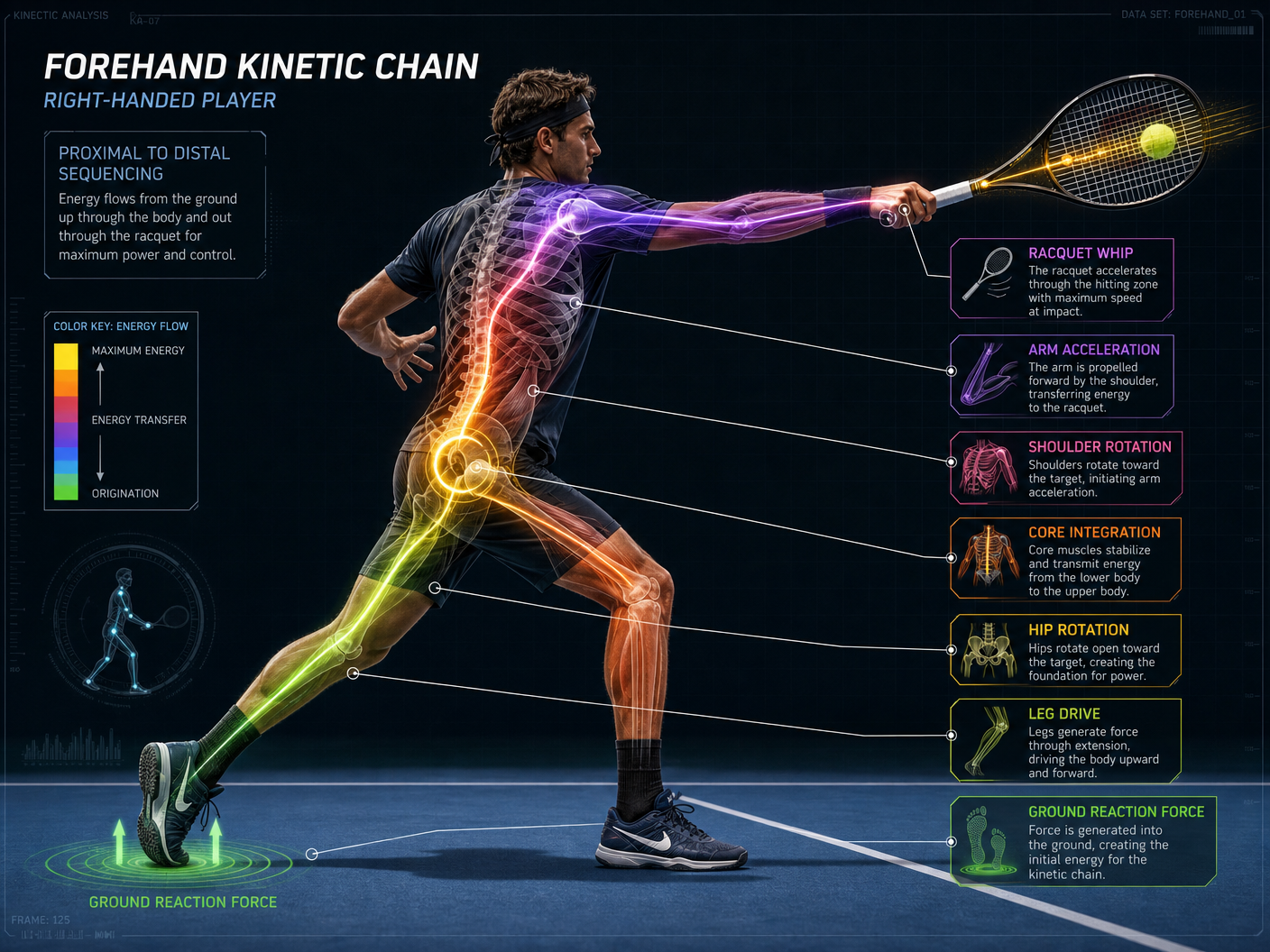
The user's system implicitly leverages several key kinetic chain principles, emphasizing the proximal-to-distal sequencing of power generation and transfer. The concept of the racquet as an extension of the arm, and the body rotating around the spine, aligns with the idea that power originates from larger, more powerful muscle groups (legs, hips, core) and transfers efficiently to smaller, more agile segments (arm, wrist, racket) [1]. The instruction to "whip instead of push" directly reflects the goal of maximizing racket head speed through sequential acceleration rather than brute force.
Tensegrity in Tennis Biomechanics
The user's emphasis on "ALWAYS HAVE TENSION BETWEEN ADJACENT JOINTS" (hip, shoulder, elbow, wrist, and racket) strongly resonates with the concept of tensegrity [2]. Tensegrity, a portmanteau of "tensional integrity," describes structural principles where discontinuous compressive elements are balanced by continuous tensional elements, creating a stable yet flexible system. In the human body, bones act as compressive elements, while muscles, tendons, ligaments, and fascia provide continuous tension. The user's instruction to "press" and "press racquet head down" suggests a deliberate pre-loading of the fascial and muscular system to store elastic energy, which is then released through rotation, rather than relying solely on muscular contraction. This creates a stable yet dynamic structure, allowing for efficient energy transfer and responsiveness [2].
The 45-Degree Plane and BIC Contact Point
The user's concept of the "45° SWING" and aiming for the "BIC (Bottom Inside Corner)" at contact aligns with advanced tennis biomechanics, particularly the "Nonlinear Tennis" system proposed by Jack Broudy [3]. The 45-degree angle is described as the bisection of the horizontal and vertical planes, representing a point of optimal control and power. By aligning the body and racket to this plane, the player can achieve a consistent and efficient contact point without actively "steering" the ball. The instruction to move "forward & to the left side of the ball" for a right-handed player further supports the idea of positioning the body to naturally meet the ball within this optimal 45-degree plane, facilitating an inside-to-outside, low-to-high swing path for topspin [3].
Structural Setpoints
The user's notes highlight several critical structural setpoints, though not explicitly named as such. These can be mapped to the framework provided in the structural-setpoints-guide.md.
Ready Position: The Foundation of Tensegrity
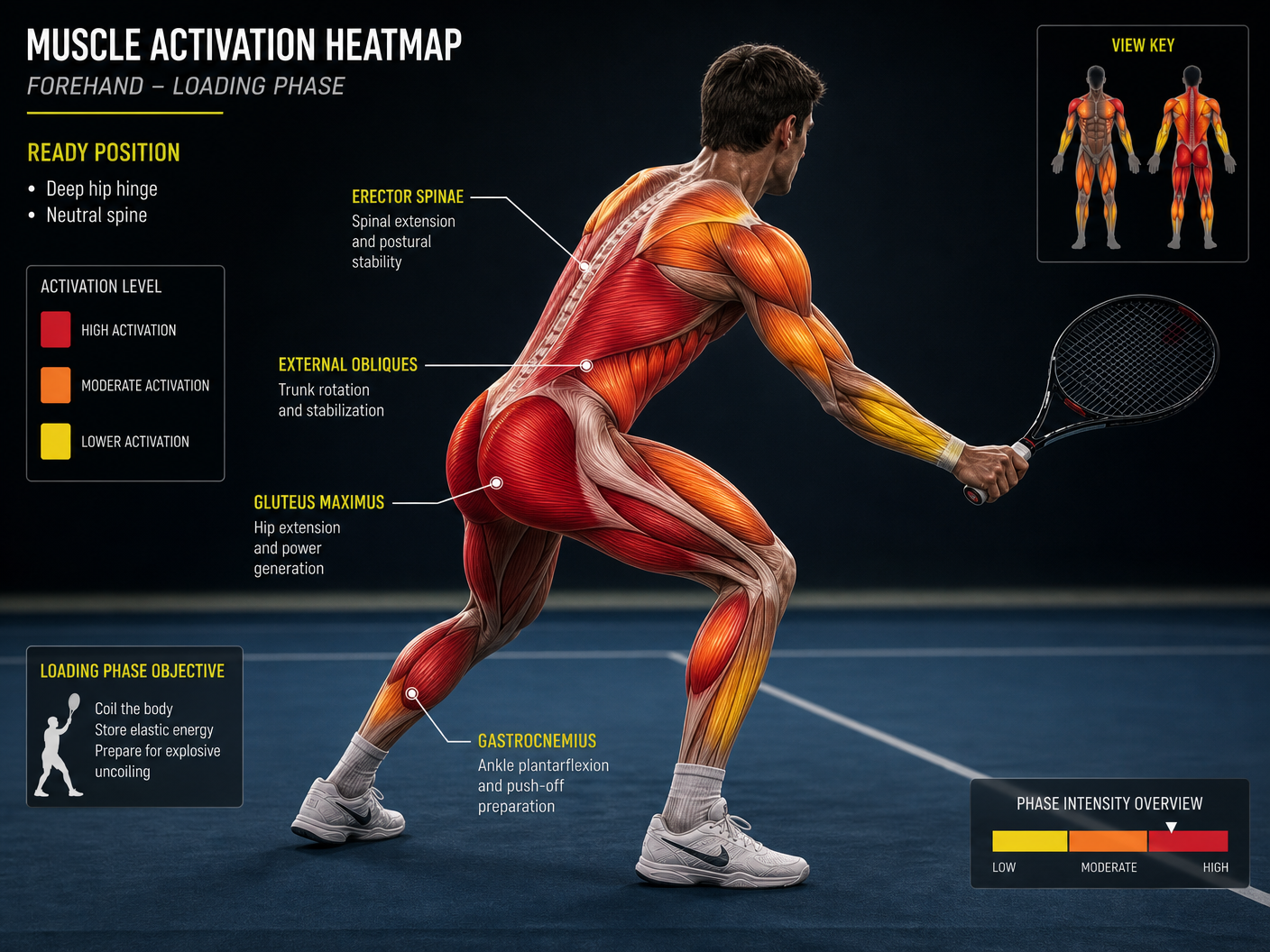
The detailed description of the "Ready Position" (Vietnamese: "Đầu ngang cao, xương sống thẳng, ngực và vai nhô ra trước, hông và mông lùi ra sau, chân hơi khuỵu") directly corresponds to the foundational setpoints of Neutral Spine and Deep Hip Flexion (Tọa Kua) [4]. The instruction to "compress against the back" when loading further reinforces the concept of engaging the posterior chain and creating a stable, pre-loaded structure ready for dynamic movement. This athletic posture ensures spinal alignment, loads elastic energy in the hips, and lowers the center of gravity for stability and responsiveness [4].
The Left Arm: Steering Wheel and Frame
The user repeatedly emphasizes the role of the non-dominant (left) arm, describing it as "high to anchor" in the run-around forehand, and forming a "frame / plane" with the shoulders in the open stance. This aligns with the Non-Dominant Arm Position setpoint, which highlights its role in reducing the moment of inertia for faster torso rotation, creating counter-rotation for energy transfer, and maintaining spinal stability [4]. The left arm acts as a crucial counterbalance and a proprioceptive anchor, allowing the hitting shoulder to rotate efficiently and preventing the player from "arming" the shot.
Grip Force Pairs: Hand Tensegrity
The user's detailed breakdown of grip mechanics, particularly the "force pairs" in the Continental and Semi-Western grips, demonstrates an intuitive understanding of hand tensegrity. Instead of merely describing where to place knuckles, the user identifies active forces (e.g., "thumb presses down from the top, three fingers lift from below" for Continental; "index drives, others counter" for Semi-Western). This ensures a stable racket face at contact, allowing the racket to become an integrated extension of the arm, consistent with the "long axis in line with the arm" principle [4].
Neurological Control Breakdown
The user's philosophy, particularly the statement that the "brain will be freed from the stroke execution details to analyze, strategize and control the match's momentum," directly reflects the concept of motor skill automation within the neurological control framework [1].
From Conscious Intent to Automated Execution
Initially, learning a stroke involves Layer 1 (High-Level Intent) and Layer 2 (Execution & Refinement), where conscious attention is paid to grip, body position, and swing path. However, the user's system aims to shift these details to Layer 3 (Automated Patterns), where Central Pattern Generators (CPGs) and learned motor programs in the spinal cord generate basic rhythmic movements (like torso rotation and arm extension) without direct cortical input. This frees up the higher brain centers (Prefrontal & Motor Cortex) to focus on Layer 1 (Intent) – tactical planning, opponent analysis, and match strategy – rather than the mechanics of the stroke itself [1].
Sensorimotor Feedback for Refinement
While the goal is automation, Layer 4 (Sensorimotor Feedback) remains crucial. The continuous real-time monitoring of body position, movement, and balance through proprioceptors and the vestibular system allows for subtle, unconscious adjustments. The user's emphasis on "tension between adjacent joints" and the "feel" of the racket becoming one with the arm enhances proprioceptive feedback, enabling the body to self-correct and refine movements without conscious intervention [1].
Performance Variations and Common Errors
Grip Variations and Their Biomechanical Implications
The user's analysis of Continental and Semi-Western grips, focusing on force pairs, provides a functional understanding of how different grips facilitate different shot types. The Continental grip, with its balanced force application, is ideal for volleys, slices, and serves where a stable, firm racket face is paramount. The Semi-Western grip, with its driving and resisting forces, enables the lag and whip necessary for heavy topspin forehands, where the racket face naturally closes through rotation [4].
Common Errors and "Watch-Outs"
The user identifies several potential pitfalls in their own system, which align with common errors in tennis biomechanics:
- Over-reliance on "pulling the racquet into the body CoG": While intended to keep contact connected, it can lead to pulling in too early, hindering extension through the contact point. The correct application involves setting the hand close during preparation and then extending out through contact [4].
- Over-equalizing forces in the Semi-Western grip: Excessive resistance can lead to a stiff wrist, negating the desired "whip" effect. A balance, perhaps 70% driving force and 30% resistance, is crucial to maintain fluidity and racket head speed [4].
- Misinterpretation of "Always press the racquet head down": While beneficial for creating tension and pre-loading, overdoing it can lock the wrist and inhibit the whip. A "light press" is key to maintaining dynamic tension without rigidity [4].
- Inaccurate contact point for high balls: The "BIC" concept is highly effective for low-to-mid balls. For high balls, the contact point will naturally be closer to the back-center of the ball, assuming height adjustment comes from leg drive rather than hand manipulation [3].
Training Framework
Based on the user's "Effortless Strike System" and the biomechanical principles discussed, a training framework can be developed to optimize skill acquisition and performance.
Phase 1: Foundational Tensegrity and Ready Position
Focus on establishing the core structural setpoints: * Neutral Spine and Tọa Kua: Practice the ready position, emphasizing hip hinge, straight spine, and engagement of the posterior chain. Use cues like "sit back into your hips as if settling into a chair, but keep your torso upright" [4]. * Joint Tension: Develop the "tension between adjacent joints" feel through slow, deliberate movements, ensuring no loose links in the kinetic chain. This builds proprioceptive awareness of the body as a connected unit.
Phase 2: Grip Mechanics and Force Application
- Grip Force Pairs: Practice the specific force applications for Continental and Semi-Western grips, focusing on the balance between driving and resisting forces to stabilize the racket face. Use drills that isolate hand and forearm movements to feel the whip effect.
- Non-Dominant Arm Integration: Incorporate drills that emphasize the role of the left arm in setting the frame, anchoring, and counterbalancing, especially during unit turn and rotation.
Phase 3: Rotational Power and the 45-Degree Plane
- Torso Rotation: Focus on generating power primarily through torso rotation, with the arm extending naturally. Use drills that minimize arm-only swinging and emphasize the body's rotational axis.
- 45-Degree Alignment: Practice positioning the body to meet the ball within the 45-degree plane, allowing the racket to travel on its natural low-to-high path. Use visual cues to aim for the BIC contact point, adjusting body height with the legs rather than manipulating the racket face.
Phase 4: Automation and Tactical Focus
- Repetition and Feedback: Engage in high-repetition drills to ingrain the correct motor patterns, allowing the stroke mechanics to shift from conscious control to automated patterns. Utilize external feedback (e.g., video analysis) to refine technique without over-thinking during play.
- Strategic Play: Once mechanics are automated, shift cognitive focus to tactical decision-making, court awareness, and opponent analysis, leveraging the "freed brain" for match control.
Conclusion
The user's "Effortless Strike System" represents a sophisticated, integrated approach to tennis biomechanics. By intuitively combining principles of tensegrity, kinetic chain sequencing, and neurological automation, the system aims to create a powerful, efficient, and cognitively unburdened stroke. The detailed analysis of grip force pairs, the emphasis on joint tension, and the understanding of the 45-degree plane and BIC contact point demonstrate a deep, functional understanding of tennis movement. Further refinement through structured training, focusing on foundational setpoints and progressive automation, can help unlock the full potential of this insightful system.
References
[1] Kandel, E. R., Schwartz, J. H., & Jessell, T. M. (2013). Principles of Neural Science (5th ed.). McGraw-Hill. (Referenced from neurological-control-framework.md)
[2] Thomas Myers - Tensegrity Applied to Human Biomechanics. (n.d.). Retrieved from https://www.youtube.com/watch?v=xzX-PeU_MTo
[3] Broudy, J. W. (n.d.). The 45 degree Angle: It’s Role in The Secret Game. TennisOne. Retrieved from https://tennisone.tennisplayer.net/content/Theories/theories.broudy/broudy.p.4/broudy.p.4.php
[4] Structural Setpoints Guide for Tennis Biomechanics. (n.d.). (Referenced from structural-setpoints-guide.md)