Comprehensive Analysis: Feedforward and Feedback Control Systems in Tennis Biomechanics
Introduction
This report provides a comprehensive analysis of the Feedforward and Feedback Control Systems in tennis biomechanics, integrating principles from neurological control theory, kinetic chain mechanics, and structural setpoints. The aim is to elucidate how the human body, particularly the Central Nervous System (CNS), orchestrates complex tennis movements through anticipatory (feedforward) and corrective (feedback) mechanisms. The analysis will draw upon the provided document, "Feedback and Feedforward Control System," and supplementary research to offer a holistic understanding of these critical control systems in tennis.
Neurological Control Framework in Tennis
The human nervous system employs a hierarchical control structure to manage the intricate movements required in tennis. This framework, as outlined in the neurological-control-framework.md skill reference, consists of four primary layers:
Layer 1: High-Level Intent (Prefrontal & Motor Cortex)
This layer is responsible for strategic planning, goal-setting, and conscious decision-making regarding the tennis stroke. It determines shot selection, desired trajectory, spin, power level, and tactical objectives, adapting to novel situations like varying ball speeds, spins, and heights [1].
Layer 2: Execution & Refinement (Basal Ganglia & Cerebellum)
This layer initiates learned movement sequences (motor programs) and continuously refines them through real-time error correction. The cerebellum plays a crucial role in comparing intended movements with actual movements, using proprioceptive feedback to adjust muscle activation, while the basal ganglia select appropriate motor programs [1].
Layer 3: Automated Patterns (Central Pattern Generators & Spinal Cord)
Central Pattern Generators (CPGs) in the spinal cord generate basic, rhythmic motor patterns without direct cortical input, such as alternating torso rotation. This reduces the cognitive load on higher brain centers, allowing them to focus on tactical decisions [1].
Layer 4: Sensorimotor Feedback (Proprioceptors & Vestibular System)
This layer provides continuous real-time monitoring of body position, movement, and balance. Proprioceptors in muscles, tendons, and joints, along with the vestibular system, supply constant feedback for movement refinement and stability [1].
Feedforward and Feedback Control in Tennis
The provided document, "Feedback and Feedforward Control System," highlights the conceptual framework of these two control mechanisms in tennis, drawing parallels between robotic and biological systems [2].
Feedforward Control (Anticipation & Prediction)
Feedforward control is an open-loop predictive mechanism that anticipates future events based on historical data and predictive models. In tennis, this translates to the brain's ability to predict an opponent's shot direction and trajectory before the ball crosses the net, based on cues like racket angle and body orientation [2]. This anticipatory mechanism allows for proactive adjustments, preparing the body for an upcoming movement [3].
Training the feedforward loop in human biomechanics involves teaching the brain to predict outcomes by utilizing internal forward models and environmental cues. Key training methods include [2]:
- Visual Occlusion Training: Forces the brain to predict trajectories with minimal visual data, such as video clips cut at racket-ball contact or digitally masked body parts.
- Kinematic Cue Recognition: Players learn to interpret an opponent's biomechanics (e.g., shoulder rotation, hip orientation, toss height) to predict shot direction.
- Perception-Action Coupling: Ensures that anticipation training is linked to physical movement, such as triggering a split-step based on a predictive brain signal.
- Pattern Recognition and Game Theory: Utilizes situational probabilities and opponent scouting to anticipate high-probability ball trajectories.
Feedback Control (Correction & Adjustment)
Feedback control is a closed-loop corrective mechanism that constantly measures the difference between the planned target and the actual position, making real-time adjustments. In tennis, this involves last-second micro-adjustments to footwork or wrist position based on real-time visual tracking as the ball approaches [2]. These responses are compensatory motor behaviors that rapidly respond to changes in the body's position to maintain balance and stability [3].
The Combined Composite System
The most effective control in tennis relies on a composite strategy where the feedforward system positions the racket to the estimated hitting point efficiently, and the feedback system fine-tunes for final-inch deviations at the moment of impact [2]. This integration allows for both proactive preparation and reactive correction, crucial for optimal performance in a dynamic sport like tennis.
Kinetic Chain Principles and Structural Setpoints
The efficient execution of tennis strokes relies heavily on the kinetic chain principles and the maintenance of structural setpoints [1].
Kinetic Chain Principles
Tennis strokes follow a proximal-to-distal sequencing, where power originates from larger muscle groups (legs, hips, core) and transfers sequentially to smaller, more agile segments (arm, wrist, racket). Each segment's peak activation occurs before the next, creating a cascading acceleration [1]. This involves:
- Ground Connection: Initiating ground reaction forces.
- Leg Drive: Generating primary power from quadriceps, hamstrings, and glutes.
- Hip Rotation: Transferring force upward.
- Core Integration: Stabilizing and transmitting rotational force.
- Shoulder Rotation: Coordinating with core rotation.
- Arm Acceleration: Accelerating upper arm, forearm, and wrist.
- Racket Whip: Accelerating the racket through the contact point.
Spiral organization and elastic energy storage and release are also integral to the kinetic chain, involving counter-rotational movements and the stretch-shortening cycle of muscles and connective tissues [1].
Structural Setpoints
Structural setpoints are critical body positions or alignments that form the foundation of efficient technique. These optimal configurations ensure spinal alignment, hip and shoulder mobility, proprioceptive accuracy, and elastic energy loading [1]. Examples include neutral spine alignment, deep hip flexion, scapular retraction, and proper wrist angles [1]. Maintaining these setpoints is crucial for both generating power and preventing injuries [4].
Muscle Activation Patterns
Research indicates that muscle activation patterns differ based on skill level and serve speed. Advanced players tend to exhibit lower muscle activity during the backswing, impact, and follow-through phases of a receive, with more consistent dominant muscles across all phases, compared to intermediate players [4]. This suggests that higher-skilled players achieve greater efficiency and power with less muscular effort, possibly due to superior motor control and kinetic chain utilization. For instance, advanced players demonstrate faster racket speed and ball speed, closer baseline placement, faster trunk turn, greater shoulder joint speed, and greater wrist flexion/extension during the stroke [5].
During perturbed running, feedback mechanisms primarily drive compensatory muscle activity and movement patterns in the perturbed leg, with limited feedforward adaptations [3]. This highlights the importance of real-time adjustments when unexpected events occur, even though feedforward mechanisms are crucial for anticipation.
Split-Step Timing and Anticipation
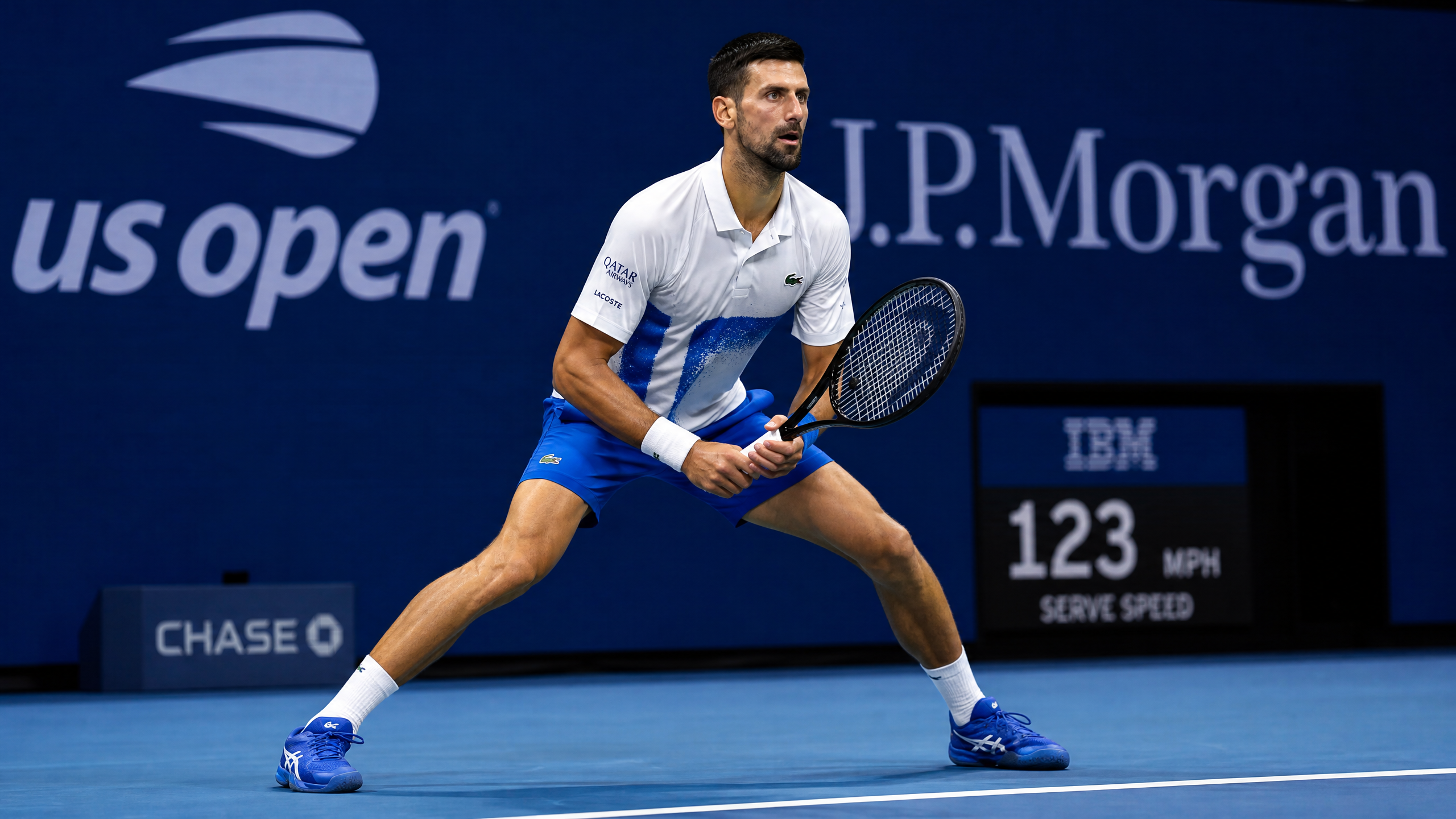
The split-step is a fundamental preparatory movement in tennis, significantly impacting a player's ability to react and move efficiently [6]. Skilled tennis players demonstrate superior anticipation, enabling them to predict opponents' actions quickly and accurately, often by observing postural orientation and employing effective visual search behaviors [6]. The timing of the split-step is critical, with players adapting their timing mechanisms to various game situations. Response times are generally lowest in the serve and gradually increase from the return of serve to baseline play [6]. The split-step allows for the storage and release of elastic energy, enhancing quick movement [6].
Visualizations
Kinetic Chain Diagram
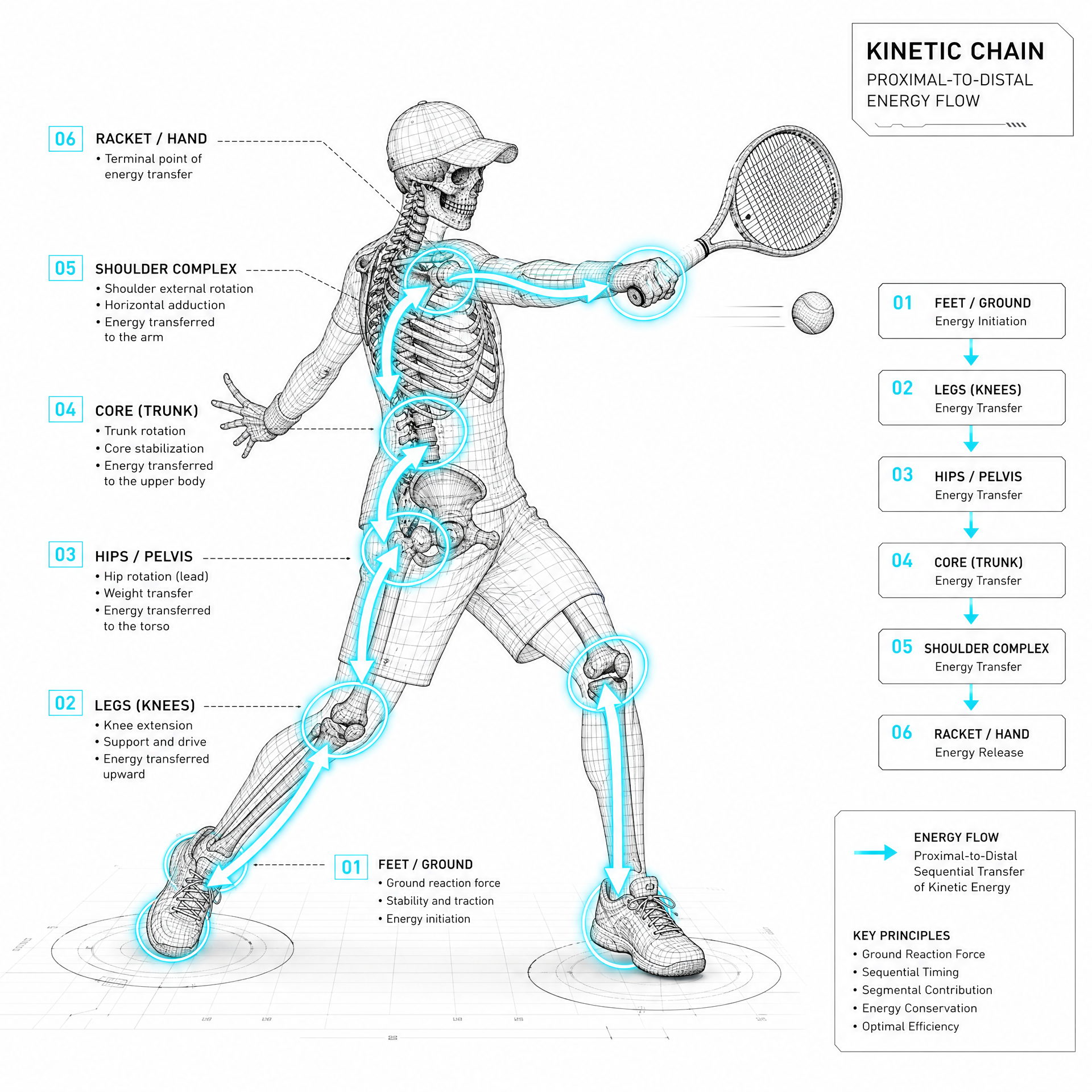
This diagram illustrates the proximal-to-distal energy transfer during a tennis stroke, a key principle of the kinetic chain. Power is generated from the ground up, moving through the legs, hips, core, and finally to the arm and racket, ensuring maximum force generation and efficient movement [1].
Muscle Activation Heatmap
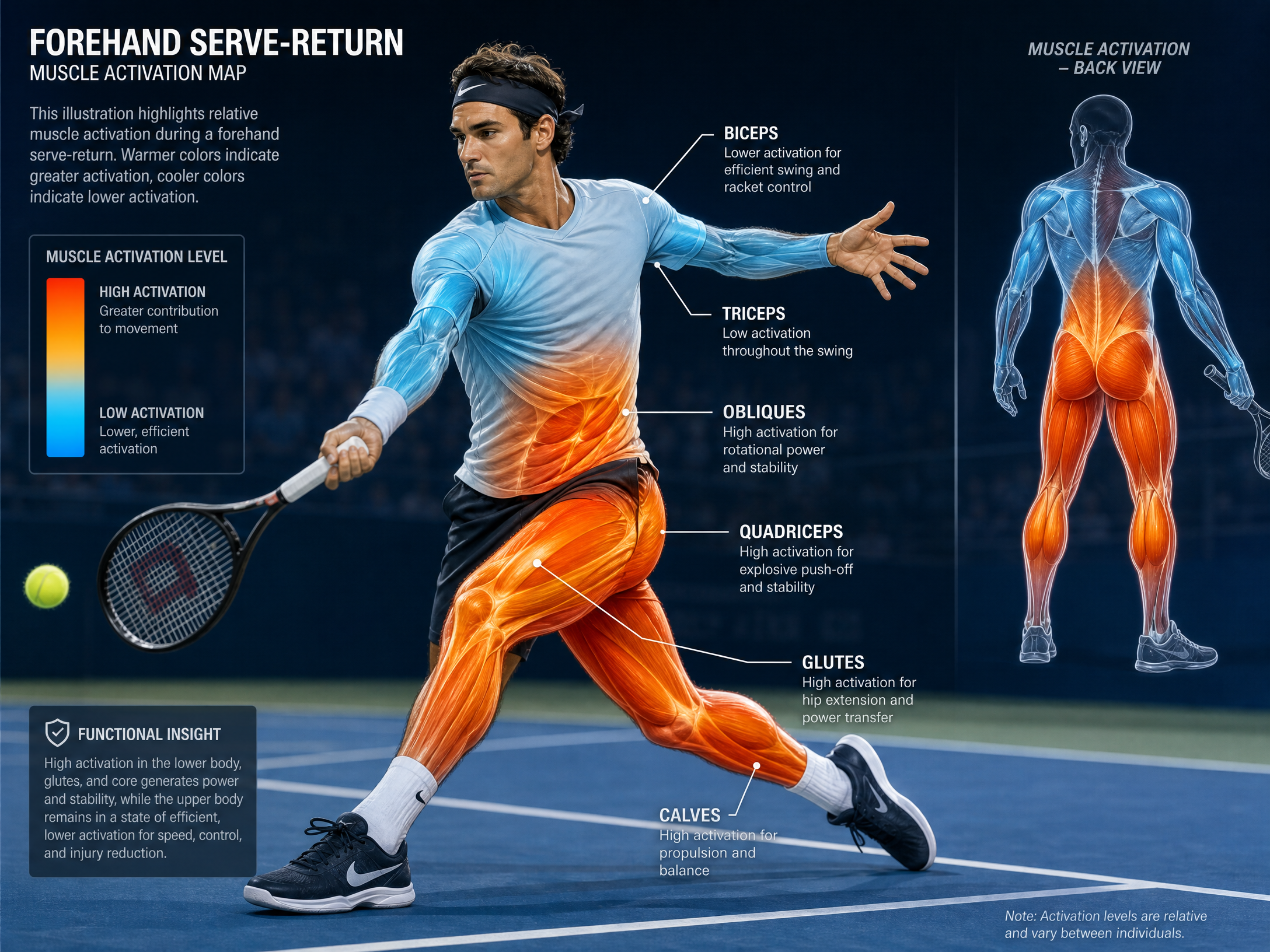
The muscle activation heatmap visually represents the differential muscle engagement during a forehand serve-return. It highlights higher activation in the lower body and core for power generation and stability, while the upper body demonstrates efficient, lower activation, characteristic of advanced players [4].
Structural Setpoints Comparison
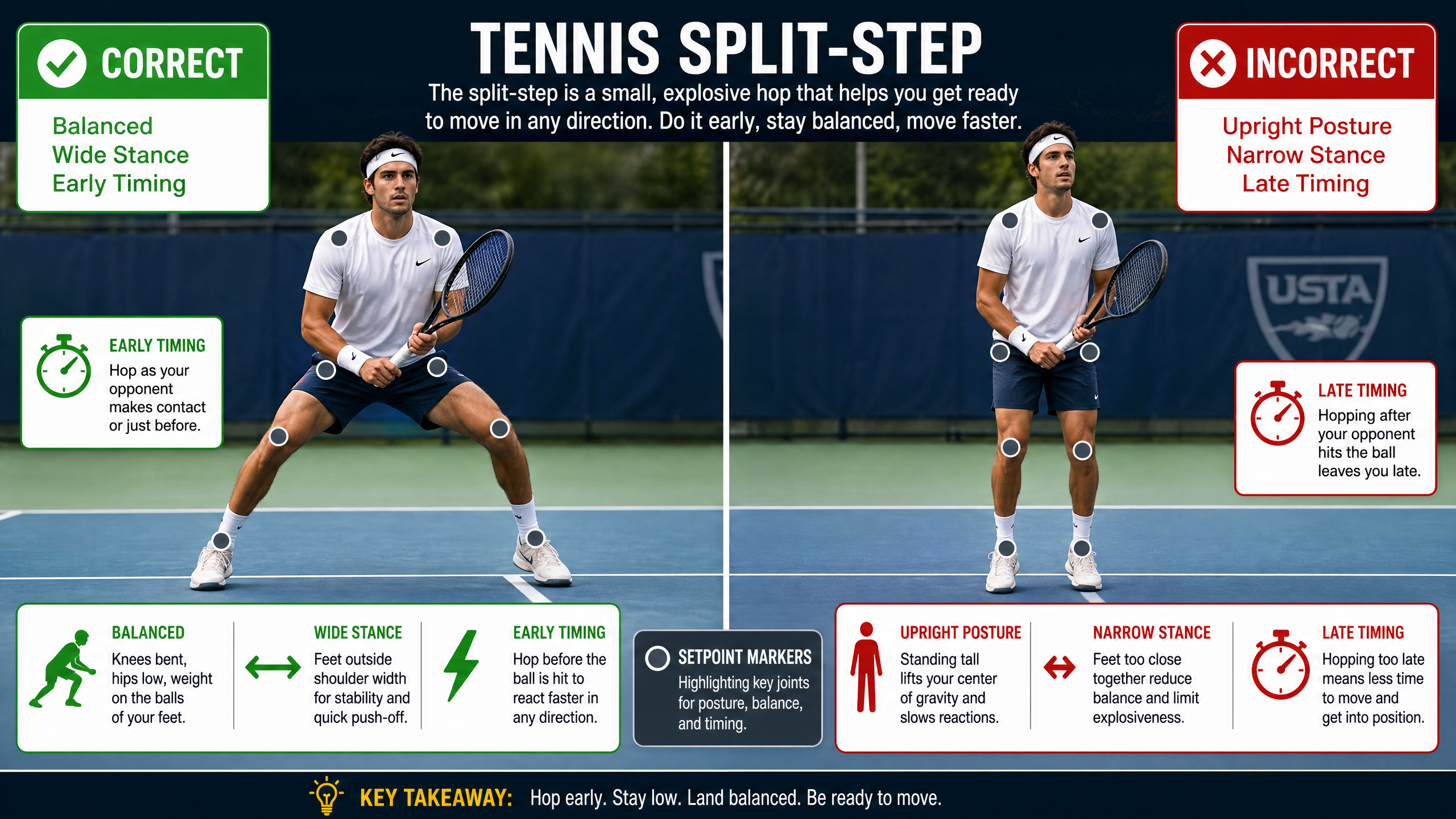
This comparison demonstrates the critical difference between correct and incorrect split-step execution. Maintaining proper structural setpoints, such as a balanced, wide stance with bent knees and early timing, is essential for optimal reaction time and movement efficiency [6].
Conclusion
The Feedforward and Feedback Control Systems are fundamental to tennis biomechanics, working in concert to enable both anticipatory action and real-time correction. The hierarchical neurological control framework, coupled with efficient kinetic chain principles and precise structural setpoints, underpins a player's ability to execute powerful and accurate strokes. Understanding and training these integrated systems, as well as analyzing muscle activation patterns and split-step timing, are crucial for optimizing performance, preventing injuries, and developing effective training methodologies in tennis.
References
- Neurological Control Framework for Tennis Biomechanics
- Feedback and Feedforward Tennis Control System
- Biomechanical feedback and feedforward responses during perturbed running in asymptomatic individuals
- The differences of muscle activation in forehand serve-receiving technique of male tennis players at different skills
- Kinematic differences in forehand serve-receiving techniques of the male tennis players at low and high-speed serves
- Split-Step Timing of Professional and Junior Tennis Players